Expected Number of Girls in a Family of 7
All our charts on Future Population Growth
Other relevant research:
World population growth – This commodity is focusing on the history of population growth up to the present. We show how the world population grew over the last several thousand years and we explain what has been driving this change.
Life expectancy – Improving health leads to falling mortality and is therefore the cistron that increases the size of the population. Life expectancy, which measures the age of death, has doubled in every region in the earth as we show here.
Fertility rates – Rapid population growth has been a temporary phenomenon in many countries. Information technology comes to an cease when the boilerplate number of births per woman – the fertility charge per unit – declines. In the article we show the data and explicate why fertility rates declined.
Age Structure – What is the historic period profile of populations around the earth? How did it change and what volition the historic period structure of populations look like in the future?
Two centuries of rapid global population growth will come to an end
1 of the big lessons from the demographic history of countries is that population explosions are temporary. For many countries the demographic transition has already ended, and every bit the global fertility rate has now halved we know that the world every bit a whole is approaching the end of rapid population growth.
This visualization presents this large overview of the global demographic transition – with the 2019 data release from the Un Population Division.
Every bit we explore at the first of the entry on population growth, the global population grew only very slowly up to 1700 – only 0.04% per year. In the many millennia upward to that betoken in history very high mortality of children counteracted high fertility. The globe was in the beginning phase of the demographic transition.
One time wellness improved and bloodshed declined things changed quickly. Specially over the course of the 20th century: Over the terminal 100 years global population more than quadrupled. Equally we see in the chart, the rise of the global population got steeper and steeper and you have simply lived through the steepest increase of that bend. This likewise means that your existence is a tiny role of the reason why that curve is so steep.
The vii-fold increase of the world population over the grade of two centuries amplified humanity'southward impact on the natural environment. To provide infinite, nutrient, and resources for a large world population in a way that is sustainable into the afar future is without question i of the large, serious challenges for our generation. We should non make the mistake of underestimating the job alee of us. Yes, I expect new generations to contribute, but for at present it is upon u.s.a. to provide for them. Population growth is still fast: Every year 140 million are born and 58 million die – the deviation is the number of people that nosotros add to the world population in a year: 82 million.
Where exercise we become from here?
In ruddy you see the annual population growth rate (that is, the percentage change in population per year) of the global population. Information technology peaked around half a century ago. Pinnacle population growth was reached in 1968 with an annual growth of 2.ane%. Since then the increase of the world population has slowed and today grows by just over 1% per year. This slowdown of population growth was not merely predictable, but predicted. Just as expected by demographers (here), the globe as a whole is experiencing the closing of a massive demographic transition.
This nautical chart likewise shows how the Un envision the slow catastrophe of the global demographic transition. As population growth continues to decline, the curve representing the world population is getting less and less steep. By the terminate of the century – when global population growth will take fallen to 0.i% according to the United nations's projection – the earth volition be very close to the end of the demographic transition. Information technology is hard to know the population dynamics across 2100; it will depend upon the fertility charge per unit and as we hash out in our entry on fertility rates here fertility is outset falling with evolution – then ascent with development. The question will be whether it will rising to a higher place an average ii children per woman.
The world enters the last phase of the demographic transition and this means we will non repeat the by. The global population has quadrupled over the course of the 20th century, just information technology volition not double anymore over the course of this century.
The globe population will reach a size, which compared to humanity's history, will be extraordinary; if the United nations projections are accurate (they have a good track record), the world population volition have increased more than 10-fold over the span of 250 years.
We are on the way to a new remainder. The big global demographic transition that the earth entered more than than two centuries ago is then coming to an end: This new equilibrium is different from the one in the past when it was the very high mortality that kept population growth in bank check. In the new residual it will be low fertility that keeps population changes small.

The UN population project by state and globe region until 2100
The chart shows the change of the total population since 1950 and from 2015 it shows the UN population projection until the end of the century.
This interactive visualization you tin can change to any other country or world region.
By switching to the map view y'all can explore the projection of the distribution of the global population.
As nosotros see here, there is a significant autumn in the population growth rate, peculiarly in the 2d half of the 21st century. Although the globe population is yet ascension at the end of the century, it's doing then very slowly. Nosotros would therefore wait growth to come to an finish very soon afterward 2100.
In this project the world population will exist around x.88 billion in 2100 and we would therefore expect 'superlative population' to occur early on in the 22nd century, at not much more than 10.88 billion.
How do we know that population growth is coming to an terminate?
- The world is reaching 'acme child'
- The past and hereafter of the global age structure
The globe is reaching 'height child'
Following decades of very fast population growth, there is often concern that population growth is out-of-control: that an end to growth is not in sight.
Only we know this is non the instance: population growth is slowing and will come to an end. How do we know? The moment in demographic history when the number of children in the world stops increasing is not far away. Information technology is the moment that Hans Rosling famously called 'peak kid' and information technology is pre-emptive of the moment in history when the population stops increasing.
Since 1950, the total number of children younger than fifteen years of age increased apace, from 0.87 billion children to 1.98 billion today. The solid green and red lines in the visualization indicate the total number of children in the globe. As we tin can see, we are not far abroad from the largest cohort of children that there volition probable e'er be. The world is approaching what the late Hans Rosling chosen "the age of peak child".
The blue line shows the total world population – rising life expectancy and falling fertility rates mean that the world population of adults will increase while the number of children is stagnating.
This is an extraordinary moment in global history. In the by, child mortality was extremely high, and simply two children per woman reached adulthood – if more had survived the population size would have not been stable. This also means that the extended family with many children, that we oft associate with the by, was only a reality for glimpse in time. Only the few generations during the population boom lived in families with many children – earlier and after two children are the norm. The future will resemble our by, except that children are not dying, just are never born in the beginning identify.
Between 1950 and today it was mostly a widening of the entire pyramid that was responsible for the increase of the world population. What is responsible for the increase of the earth population from now on is not a widening of the the base, but a fill up of the population above the base. Not children will be added to the globe population, but people in working age and former historic period. At a land level "peak child" is followed by a fourth dimension in which the state benefits from a "demographic dividend". The demographic structure of a country is reshaped and so that the proportion of people in working historic period rises and that of the dependent young generation falls. The demographic dividend tin result in a rising of productive contributions and a growing economic system.1 Now there is reason to expect that the world as a whole benefits from a "demographic dividend".
The big demographic transition that the globe entered more than a century ago is coming to an finish: Global population growth peaked half a century ago, the number of babies is reaching its peak, and the historic period profile of the women in the world is changing so that 'population momentum' is slowly losing its momentum. This is not to say that feeding and supporting a even so ascension world population will be piece of cake, but we are certainly on the way to a new residue where it's not high mortality keeping population growth in check, but low fertility rates.
The past and future of the global age construction
In 1950 at that place were two.5 billion people on the planet. At present in 2019, there are 7.7 billion. By the end of the century the Un expects a global population of 11.2 billion. This visualization of the population pyramid makes it possible to empathize this enormous global transformation.
Population pyramids visualize the demographic structure of a population. The width represents the size of the population of a given age; women on the right and men to the left. The bottom layer represents the number of newborns and higher up information technology you lot find the numbers of older cohorts. Represented in this way the population structure of societies with loftier mortality rates resembled a pyramid – this is how this famous type of visualization got its name.
In the darkest blue you encounter the pyramid that represents the structure of the world population in 1950. Ii factors are responsible for the pyramid shape in 1950: An increasing number of births broadened the base layer of the population pyramid and a continuously high risk of death throughout life is evident by the pyramid narrowing towards the meridian. There were many newborns relative to the number of people at older ages.
The narrowing of the pyramid just above the base of operations is testimony to the fact that more than one-in-5 children born in 1950 died before they reached the historic period of v.2
Through shades of blue and green the same visualization shows the population structure over the last decades up to 2018. You see that in each subsequent decade the population pyramid was fatter than before – in each decade more people of all ages were added to the world population.
If you look at the green pyramid for 2018 you run across that the narrowing above the base is much less strong than back in 1950; the child bloodshed rate cruel from 1-in-5 in 1950 to fewer than 1-in-20 today.
In comparing 1950 and 2018 nosotros see that the number of children born has increased – 97 million in 1950 to 143 meg today – and that the mortality of children decreased at the same time. If you now compare the base of the pyramid in 2018 with the projection for 2100 you run across that the coming decades volition not resemble the past: According to the projections in that location will exist fewer children born at the end of this century than today. The base of operations of the futurity population structure is narrower.
We are at a turning betoken in global population history. Between 1950 and today, it was a widening of the unabridged pyramid – an increase of the number of children – that was responsible for the increase of the earth population. From now on is non a widening of the base, but a 'fill upwardly' of the population in a higher place the base of operations: the number of children will barely increment and so start to decline, but the number of people of working age and old age will increase very substantially. Equally global health is improving and mortality is falling, the people alive today are expected to alive longer than any generation before u.s.a..
At a state level "peak child" is frequently followed by a time in which the country benefits from a "demographic dividend" when the proportion of the dependent young generation falls and the share of the population in working historic period increases.4
This is now happening at a global scale. For every child younger than 15 there were one.8 people in working-age (xv to 64) in 1950; today there are ii.5; and by the end of the century at that place will exist 3.iv.five
Richer countries have benefited from this transition in the last decades and are at present facing the demographic problem of an increasingly larger share of retired people that are not contributing to the labor marketplace. In the coming decades it will be the poorer countries that tin do good from this demographic dividend.
The change from 1950 to today and the projections to 2100 show a world population that is becoming healthier. When the meridian of the pyramid becomes wider and looks less like a pyramid and instead becomes more box-shaped, the population lives through younger ages with very low risk of death and dies at an old historic period. The demographic structure of a healthy population at the final stage of the demographic transition is the box shape that we see for the entire earth for 2100.
The Demography of the World Population from 1950 to 2100iii

Population growth by world region
More than than 8 out of x people in the world are expected to live in Asia or Africa past 2100
The United Nations projects that earth population growth will tiresome significantly over the course of the 21st century, coming close to its peak at 10.ix billion by 2100. But how is this growth distributed across the world? How does the world expect in 2100 compared to today?
In this chart we see the global population split by region. This shows historical data, simply as well projections to 2100 based on the UN's medium growth scenario.
The striking change between at present and 2100 is the expected growth in the African population. Today, its population is effectually 1.iii billion; by 2100 information technology'due south projected to more than than triple to 4.3 billion.
Over the past fifty years Asia experienced rapid population growth. Today its population stands at around iv.6 billion. Past 2050 it'due south expected to ascent to 5.iii billion, simply and then fall in the latter half of the century. You can read more than about the driving strength behind these demographic changes here. By 2100 Asia'southward population is projected to fall about dorsum to levels nosotros see today.
You tin can utilise the 'relative' toggle in the nautical chart to see each region's share of the world population. Here nosotros come across that today Africa has just over 17% of the global population; by 2100 this is projected to ascension to xl%. Asia will come across a pregnant fall from almost 60% today to just over 40% in 2100.
By the finish of the century, more than than 8 out of every x people in the world volition live in Asia or Africa.
North, Cardinal and Southward America, and Oceania, are projected to also see a rise in population this century – but this growth will exist much more modest relative to growth in Africa. Europe is the only region where population is expected to fall – today its population stands at around 747 million; by 2100 this is projected to fall to 630 million.
These changes will bring new opportunities and challenges. Extreme poverty, for example, is expected to get increasingly concentrated in Africa in the decades which follow. This will correspond a major shift from the century before.
Future population by land
Bharat volition shortly overtake Red china to become the nearly populous country in the globe
China has been the world's most populous country for a long time: dorsum in 1750, information technology had a population of 225 1000000, around 28% of the world population.6
By 2016, China had a population larger than 1.4 billion.
But China is shortly to be overtaken by India. In the chart here we run across historic and projected population past country, spanning from 10,000 BCE through to 2100. The projections – made by the UN's Population Division – suggest that by 2027, India will surpass China to get the earth'south virtually populous country.
Projections are always associated with a caste of incertitude and this means the crossing point could exist a few years earlier or later. Merely even within this caste of uncertainty, it'southward expected that India will become the virtually populous land within the next decade.
Rapidly failing fertility rates – from an average of 6 children down to 2.4 children per woman – in Bharat means its population growth has fallen significantly over the last few decades. This means that while it will be the nigh populous country for the rest of the century, it'due south expected to achieve 'meridian population' in the late 2050s at around 1.seven billion earlier slowly falling in the second one-half of the century.
What does the future population of other countries expect like?
In the map nosotros see country populations across the earth through to the year 2100. By clicking on whatever state y'all can come across how its population has changed since 1950, and its projections over the 21st century.
The population growth rate past country
Global population growth has slowed down markedly since the tiptop in the 1960s. This map shows the growth rate by country at the elevation of global population growth in 1968.
By moving the fourth dimension slider you can explore how growth rates around the earth have changed over time
Projections of the drivers of population growth
- Births and deaths
- Population growth comes to an end when fertility rates decline
At the global level population growth is determined by the number of births and deaths.7 To empathize the likely trajectory for population growth we demand to examine how births and deaths are changing – and, one level deeper, what is happening to those factors which in plow touch them. Increasing life expectancy and falling child mortality in every state are of course increasing population numbers. The countervailing trend are falling fertility rates – the trend of couples having fewer children is what brought rapid population growth to an stop in many countries already, and what will bring an end to rapid population growth globally. Nosotros are looking at all of these drivers separately.
In the entry on global population growth we are explaining how births, deaths, and migration are driving population growth. There nosotros are also discussing the demographic transition equally the central concept that explains why rapid population growth is a temporary phenomenon.
Births and deaths
The earth population has grown rapidly, particularly over the by century: in 1900 at that place were fewer than two billion people on the planet; today there are seven.7 billion.
The change in the globe population is adamant by two metrics: the number of babies born, and the number of people dying.
How many are born each year?
The stacked expanse nautical chart shows the number of births past world region from 1950 to 2015.
In 2015, there were approximately 140 million births – 43 1000000 more than back in 1950
The line chart shows the same data, just also includes the Un project until the end of the century. It is possible to switch this nautical chart to any other country or world region in the world.
How many die each year?
The get-go nautical chart shows the annual number of deaths over the same menstruum.
In 2015 around 55 million people died. The earth population therefore increased by 84 million in that twelvemonth (that is an increase of one.14%).
The line chart shows the same data, but also includes the Un projection until the cease of the century. Again it is possible to switch this chart to any other country or earth region in the world.
As the number of deaths approaches the number of births global population growth will come up to an end
How practise we expect this to change in the coming decades? What does this hateful for population growth?
Population projections show that the yearly number of births volition remain at effectually 140 one thousand thousand per year over the coming decades. It is then expected to slowly decline in the second-one-half of the century. Every bit the world population ages, the annual number of deaths is expected to continue to increment in the coming decades until it reaches a similar almanac number equally global births towards the end of the century.
Every bit the number of births is expected to slowly autumn and the number of deaths to rise the global population growth rate will go along to fall. This is when the world population will stop to increase in the future.
Projections of births and deaths
This view compares the number of annual births to the number of deaths.
From 2015 onwards it shows the UN Population Projections.
It is possible to change this view to any country or earth region.
Projections of the fertility rate
The visualization shows the total fertility rate – the number of children per woman – by the level of evolution and includes the UN projections through 2099.
The global boilerplate fertility charge per unit was 5 children per woman until the stop of the 1960s and has halved since then.
Until 1950, the fertility rate in the 'more adult regions' had already declined to less than iii children per woman. And then, in the 1960s the fertility rate in the 'less developed regions' started to fall and another decade later the fertility rate in the 'least adult regions' followed this decline.
Projections of life expectancy
As health is chop-chop improving around the world, life expectancy is also increasing rapidly. You tin can read more than about life expectancy at the our life expectancy data entry.
Population growth comes to an end when fertility rates decline
In the past bloodshed rates were and then high that they kept population growth in check. This is not the case in the 21st century.
Population growth is high where child mortality is loftier
This correlation is surprising to many: Child mortality is inversely correlated with population growth.
Where child mortality is loftier the population grows fast. A major reason for this correlation is that the fertility rate is high where kid bloodshed is high. You find our enquiry on this link here.
The correlation betwixt the fertility rate and population growth
Where the fertility rate is high population growth is loftier.
Population growth comes to an finish when fertility rates reject and nosotros studied the reasons why fertility rates decline in item in our entry on fertility rates.
How accurate accept past population projections been?
The Un projects that global population will accomplish 9.7 billion people in 2050, and population growth about coming to an end at 10.8 billion in 2100.
Should we believe these projections?
Ane mode to gauge the brownie of Un projections for the futurity is to await dorsum at its runway record of predictions in the past.
Every few years the Un publishes its latest population statistics, covering historical and electric current estimates, and future projections. Each release of these statistics is called a revision, and allocated the twelvemonth of publication (e.g. 1990 Revision). The latest revision in 2017 was the UN's 25th publication.
In this chart we run into comparing of various UN Revisions of world population, dating back to the 1968 publication. Shown equally the solid line is the latest 2017 Revision, which nosotros can consider to be the 'actual' population size upwards to 2015.
Here we see that although each revision provided different projections, most turned out to be relatively close. For case, it'south estimated that the global population in 1990 was 5.34 billion. Most projections were close to this value: even the earliest revision in 1968 projected a 1990 population of v.44 billion.
In 2010, it'south estimated the global population was 7 billion; previous projections were in the range of vi.viii to 7.2 billion. In 2015, the global population was estimated to be seven.4 billion; the 1990 Revision overestimated with a projection of 7.seven billion whilst the 1998 Revision underestimated at 7.ii billion.
Like results are true for United nations projections even earlier than the 1970s. Kielman (2001) looked at how Un projections from 1950 to 1995 matched with the actual population figures.8
Projections as far dorsum as 1950 were remarkably close to the later estimates.
There are of course many factors which will influence the rate of population growth in the coming decades. Projections go increasingly uncertain (and tend to converge most) the further into the futurity they get. This ways nosotros'd expect college uncertainty in projections for 2100 than those for 2050.
Future projections volition continue to be refined over fourth dimension. Nonetheless, the surprising accuracy of historical projections should give u.s. confidence that although imperfect, Un population projections have usually turned out to be very close to the truth.
Different population projections
- The Un projections
The United nations projections
The most widely discussed projections are those published by the United Nations, the showtime of which were published already in 1951.
The Un projections are chosen 'assessments' and a new update is published in their World Population Prospects series every two years.
The different variants of population projections past the UN
Shown here is the increase of the world population since 1750 combined with the latest projections of the UN Population Division.
The Un publishes several variants of their population projections:
- The Medium Variant is the projection that the Un researchers encounter as the about likely scenario. This is the source of the bulk of projections shown here.
- The High- and Low-Variants are based on the Medium Variant and but presume that the full fertility rates in each country are 0.five higher and 0.5 lower than the Medium variant by the terminate of this century in every state.9
- The Constant Fertility Scenario is an illustrative scenario that plays out how the earth population would change if fertility rates remained constant. It is apparently not intended to exist a realistic scenario.
Other projections
But at that place are also a number of other institutions that are preparing their own projections of the world population.
Global population projections are likewise published past the US Census, the Population Reference Bureau (PRB), and by the closely related Austrian research centers IIASA and the Wittgenstein Centre.
The World Banking company also published projections for some time but has stopped doing so in the mid–90s.
The WC-IIASA projections
In this entry we are focusing mostly on the UN's medium variant projections. But these are certainly not the simply projections.
There are a range of projections for time to come population growth. These differ based on ii key factors: the modify in fertility rate and life expectancy over time.
All future projections of global population are uncertain. Much of the incertitude comes from the fact that we do not know how the drivers of population growth will change. The central driver of population change in the 21st century is not mortality, simply fertility, as we have seen earlier. And fertility rates are adamant by a number of factors that change rapidly with evolution. If the world develops faster we can await a smaller earth population. Investments the world will make in those systems that make up one's mind bloodshed and fertility – most importantly in education, as nosotros take just explored.
The WC-IIASA projections are a fix of influential projections, published by IIASA and the Wittgenstein Center,x and are helpful to gauge how much smaller the world population will be if the earth develops faster.
Their key deviation to the United nations projections are that they are scenarios – they tell us what happens tomorrow depending on what nosotros do today. But in that location are other differences besides.
Differences betwixt the UN and WC-IIASA projections
The WC-IIASA projections differ from the work of the United Nations in a number of cardinal ways.11
The UN projections are taking into business relationship the empirical information on each land's demography and are building projections based on this quantitative information. In contrast to this the WC-IIASA projections are as well taking into account the qualitative assessments of 550 demographers from effectually the globe which the WC-IIASA researchers accept surveyed to gather their ideas on how the population change in different parts of the world will play out. They so combine the country specific expertise of these researchers with similar quantitative information that the United nations and others rely on as well.12 The piece of work by WC-IIASA is highly respected amidst demographers and primal publications past the researchers are regularly published in the scientific journal Nature.13
The WC-IIASA projections are taking into business relationship the demographic construction of the educational attainment of the population. While other projections are only structuring the demographic data past sex and age-group, the WC-IIASA information is additionally breaking downward the population data by the level of highest educational attainment of unlike parts of the population. This data on educational attainment is then used for both the output of the model – so that population projections for each state of the globe by highest educational attainment are bachelor (also on Our Earth in Data). And crucially the information on education is besides used as an an input into the model, so that the affect of different future scenarios for education on both mortality and fertility tin be modeled explicitly.
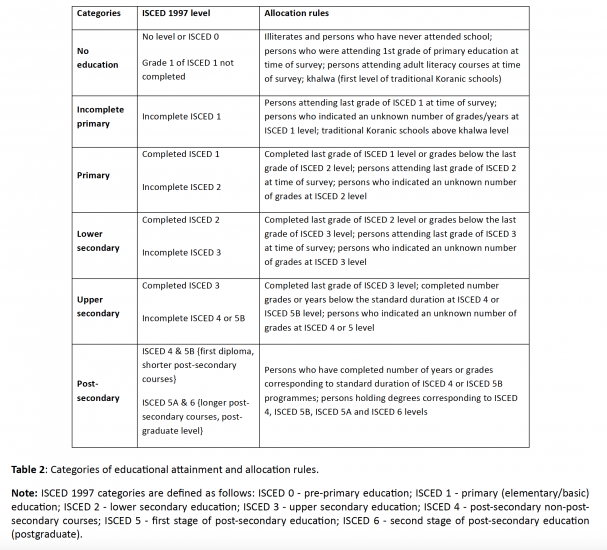
The level of highest educational attainment is categorized in a organization that aims to capture the construction of populations across the different country-specific educational systems. These categorizations are based on the the International Standard Classification of Education (ISCED), which was designed past the UNESCO to make education statistics comparable across countries. WC-IIASA breaks down the educational structure into the post-obit half-dozen categories and the tabular array summarizes how the half dozen categories are defined, how they correspond to ISCED 1997, and the master allocation rules the researchers used.
For children younger than 15 years old no educational attainment information is available as most of them are still in the process of education.
Categories of educational attainment used by IIASA-WC and how they correspond to the ISCED levels14
The four scenarios for global pedagogy past WC-IIASA
Projections of the global population take into account how the fertility rate will change in each state over the coming decades. The WC-IIASA projections are particularly helpful for the give-and-take here as they are the only projections that suspension down the demographic projections by the educational level of the populations and and then model how different educational scenarios would affect the fertility rate in countries beyond the world. This then allows comparisons of how instruction matters for the size and distribution of the future population of the planet.
The researchers developed 4 unlike bones scenarios and a larger number of combinations based on these scenarios:
Constant Enrollment Numbers (CEN): This is the researcher'due south most pessimistic scenario. Hither it is assumed that no more than schools are beingness opened in any place in the world so that the accented number of people reaching a detail educational level is frozen at the electric current number. This means that enrollment rates are declining when the population size increases.
In practice the WC-IIASA researchers nearly ever consider CER as the about pessimistic scenario and only rarely discuss CEN.
Constant Enrollment Rates (CER): This is another pessimistic scenario. While in the CEN scenario the absolute number of enrolled students stagnates, the assumption in the CER scenario is that the rate of enrollment stagnates. In this scenario the most recently observed rates of educational enrollment are frozen at their current charge per unit and no farther comeback in enrollment is assumed.
This will all the same result in further improvements of adult education because in many countries the younger cohorts are better educated than the older ones. But in the longer run this scenario also implies stagnation.
Fast Track (FT): This scenario is the almost optimistic one and here it is causeless that countries follow the most rapid pedagogy expansion achieved in recent history which is that of S Korea.
Global Teaching Trend (Become): This is the middle scenario and here the researchers assume that countries volition follow the average path of educational expansion that other countries already further advanced in this procedure have experienced. In this scenario the researchers project the medium future trajectory based on the experience of all countries over the past 40 years
The researchers write: "The Get scenario is moderately optimistic, and can be considered as the nigh likely."15
The size and construction of the world population under different educational scenarios
At present we can see how the size of the total world population and the educational achievements of this population will evolve under these iv scenarios.
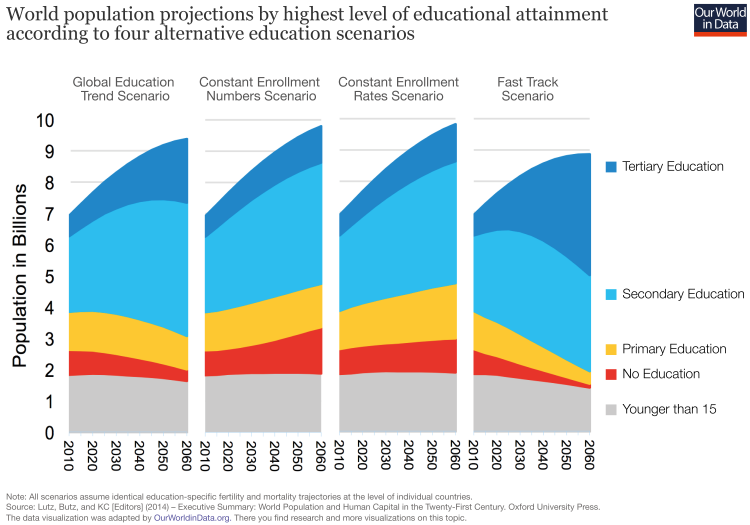
In this visualization nosotros see that how fast education will become available in the short term will thing very substantially for the size of the world population in the longer-term – even for the evolution of world population over the next 5 decades.
By 2060 the globe population is projected to reach ix.8 billion nether the Constant Enrollment Rates (CER) scenario, which is pessimistic most improvements in global instruction. If we assume optimistic progress in global educational activity, as in the Fast Track (FT) scenario, then global population is projected to increase to merely 8.9 billion. A deviation of almost one billion – every bit early on as 2060 – may therefore be solely driven past differences in progress on global education.
This finding – culling education scenarios alone make a difference of 1 billion for the global population over such a brusk fourth dimension-frame – is discussed in more detail in a publication in Science past Lutz and KC (2011).16
While the differences between the educational scenarios are slow to materialize and only show upwardly after some decades,17 they are then very substantial and matter hugely for the size of the future world population. Whether or not the world is making fast progress in making education available to more children faster will thing for the size of the global population in but a few decades.
World population projections by highest level of educational attainment according to four alternative educational activity scenarios18
Global need for educational activity: The population of school-historic period children
And the size of the cohort of schoolhouse children in turn, will of course thing how easy or hard it is to make instruction available for all. Let's see how different possible scenarios in educational improvements matter for 'peak child' and the size of the population in schoolhouse historic period.
For this we rely on scenarios of the WC-IIASA researchers which differ just in the assumptions on educational attainment.19
The visualization beneath shows the three projections of the size of the population of school-age-children until the terminate of this century:
- According to the projection of the pessimisticConstant Enrollment Scenario the population younger than 15 will evolve similarly to the Medium Variant project of the UN: the number of children volition proceed to increase slowly and reach a plateau in the mid-21st century earlier the population will decline to a size like to today's population of under-15-yr-olds.
- The medium projection of WC-IIASA – the projections they run into as most likely – substantially differs from the UN'southward Medium projection: In the most likely scenario – Global Didactics Trends (GET), which the WC-IIASA researchers see as a continuation of the recent educational trends – the size of the population younger than fifteen will soon start to fall and at the end of the century the population of under-15-year-olds will be one-third smaller than today! According to this eye-of-the-route scenario by WC-IIASA the globe is very close to 'child peak'.
- Even faster volition be the decline in the Fast Track scenario. If the world can achieve such a rapid expansion of instruction, and so the size of the population of under-fifteen-year-olds is projected to fall and turn down to just i billion in 2100 (almost the same level as 1950).
What this comparison of scenarios shows us is that the size of the global population younger than 15 – the upper jump for the global demand for didactics – will very much depend on how rapidly access to pedagogy tin be extended.twenty
A larger increase in the educational attainment in the brusque-run will mean that the size of cohorts that need investments in the long-run will be much smaller: The divergence betwixt no farther improvements in the educational enrollment (CER scenario) and a continuation of the successful last decades volition mean that the global population of under-xv-year-olds will be half a billion smaller at the terminate of the century. An acceleration to the Fast Track (FT) scenario would mean that this global figure is again smaller past yet another 200 million children.
Projections of the total population – United nations vs IIASA-WC
So far we have looked at the total figures for the global population. What nosotros have not yet taken into account is how the size of the population will evolve in dissimilar regions and countries of the world.
Total population: UN
The Medium Variant of the UN projections for all world regions until the end of this century is shown in this chart. Changes to the population size of the Americas, Oceania, and Europe are very small compared to the big expected changes in Asia and Africa. The Un expects the population of Africa to increase iii.iii-fold – from 1.iii billion in 2019 to iv.28 billion by the finish of the century. The population of Africa then will be as large as the population of Asia today, and the rate of this increase in the coming decades will also be very like to the rate of population growth in Asia over the last few decades (Asia's population increased from one.4 billion in 1950 to four.half dozen billion today).
For Asia, the UN projects an increase only until the mid-21st century when population is projected to plateau around v.3 billion. In the 2nd half of the 21st century, the demographers foresee a decline of the Asian population to less than 5 billion by 2100.
Total population: WC-IIASA
This visualization shows in contrast the projections of the WC-IIASA researchers. Once again the projected changes in the Americas, Oceania, and Europe are modest compared to changes in Africa and Asia.
For Asia, this medium scenario by WC-IIASA projects an evolution that is very similar to the Un projection: The population will increase until the mid-21st century when the population plateaus (on a slightly lower level than in the UN projections) and then falls to well below 5 billion until the year 2100.
The big difference is Africa: While the United nations projects that the population of Africa volition increase iii.5-fold, the WC-IIASA researchers expect only a doubling. The demographers wait the African population to stay well below iii billion, with population growth well-nigh coming to a halt at the end of this century.
The projections by education scenario tin can be seen in this nautical chart.
Fertility charge per unit – Un vs IIASA-WC
As we have seen above, the crucial variable for how the world population volition evolve is the total fertility charge per unit: the number of children per woman. Let'due south see how this crucial variable is projected to evolve.
At that place is some doubtfulness almost the level of the fertility rate today in some countries with poorer coverage of demographic statistics. This discrepancy in estimates today is also obvious in the comparing of the United nations and WC-IIASA, where the United nations mostly assumes that fertility rates today are higher than those causeless by WC-IIASA.
For the development over the next century nonetheless the changes over fourth dimension are more than primal. And so let's see what the projections of the Un and WC-IIASA entail.
Fertility rate: Un
The Un serial shows that until 1966 women around the world had more than than 5 children on average. Since then the fertility rate has halved and is now just below 2.v children per woman. The Un projects that the fertility charge per unit volition further reject to two.1 in 2070 and by the end of the century the fertility charge per unit volition fall below 2. A global fertility rate of 1.93 then would imply a decline of the global population over the long run.
In Africa the fertility rate only brutal below 5 in 2005 – 4 decades subsequently than the global boilerplate. For the 21st century the UN Medium Variant projects a tiresome reject of the fertility rate in Africa to 2.1 children per woman until the cease of the century.
Fertility rate: WC-IIASA
In their medium scenario – SSP2 with the GET assumptions on global education – the researchers project a much faster pass up of the fertility rate than the United nations. Equally early equally the 2050s, the fertility rate will fall below two and past the stop of the century will exist 1.68 children per woman.
Africa too will reach a fertility rate below two by the 2070s under the medium assumptions – y'all can add together the projections for Africa by clicking the option "add project" below the chart.
Interestingly the projections for the total fertility rate under the pessimistic Constant Enrollment Rates (CER) scenario are over again very similar to the UN Medium projection. Under this scenario the WC-IIASA researchers project a global fertility rate merely below 2 and a fertility charge per unit for Africa just in a higher place two. The pessimistic scenario of WC-IIASA is similar to the UN Medium project, and all of the more optimistic WC-IIASA scenarios imply lower fertility rates. In these optimistic scenarios, the global population is therefore significantly smaller at the end of the century, with smaller cohorts of school-age children throughout this menstruation.
In past decades United nations demographers have been consistently too pessimistic in their projections of the global fertility rates as we show in our assessment of the past UN projections.
Population younger than 15: UN vs WC-IIASA
To run into how the number of children in schoolhouse historic period will evolve in unlike parts of the world, below we look at the population younger than xv in all earth regions separately and again compare the projections by the UN with those by WC-IIASA researchers.
Population younger than 15: United nations
Shown below are the UN projections until the year 2100. Once more, annotation the familiar picture of stagnating population sizes in Oceania, the Americas, and Europe. Due to the low fertility rates in Asia, the Un projects a substantial subtract in the number of nether-15-twelvemonth-olds over the coming decades, falling from 1.ane billion today to just under 0.7 billion past 2100.
For Africa the Un projects an increase from 0.5 billion under-15-year-olds today to a peak of almost one billion in the 2090s when the number of children at school age is projected to start to decline.
Population younger than 15: WC-IIASA
Now let us compare this with the projection of the globe population past world region according to the medium projection of WC-IIASA – the SSP2 scenario with the GET supposition on global educational improvements.
For Asia the researchers project an even more substantial decline to just over half a billion in the year 2100.
An even more than substantial difference is projected for Africa where they project that the increase of the school-age population comes to an cease beneath 600 million as early as 2050. By the stop of the century the researchers wait a population of under-15-year-olds that is barely larger than today.
Whether the world population will reach ten billion volition likely depend on Africa
What we take seen in the different projections of futurity global population is that hereafter population growth in Africa is the most influential and contentious question. What happens in Africa now and in the coming decades volition determine what size and construction the global population will have at the end of the century.21
There is considerable disagreement between Un and WC-IIASA projections. Fifty-fifty the medium projections vary significantly between the 2 institutions: The United nations projects a population of 4.5 billion while WC-IIASA projects a population of only 2.6 billion. This difference of 2 billion is merely as big as the difference betwixt the projection for the global population past the UN (11.2 billion in 2100) and WC-IIASA (8.9 billion in 2100). Whether the world population increases to more ten billion will be decided by the speed with which Africa develops – particularly how rapidly women get admission to ameliorate pedagogy, women's opportunities within the chore market, and how rapidly the improvements in child health continue.
This also matters significantly for some detail countries: For instance, in Nigeria (currently a population of 190 meg) the Un projects a population of 794 million at the end of the century. WC-IIASA, however, projects the population to be more than 25 per centum smaller at 576 million.
Currently the total fertility rate in Africa even so stands at 4.iv children per woman, according to the UN. It took 42 years (from 1972 to 2014) for global fertility to fall from iv.five to ii.five children. The UN projects that for Africa it will accept longer than that – 56 years (from 2016 to 2072) – while the WC-IIASA researchers project a faster decline.
At that place are reasons to exist optimistic that Africa could develop faster than the projections of the UN assume:
We know that falling bloodshed is associated with a decline of fertility. And health in Africa is improving chop-chop:
– The child mortality rate in Africa has halved over the last two decades.
– HIV/AIDS is however a serious threat, only the epidemic is past its elevation and the incidence rate in Sub-Saharan Africa has fallen by ii thirds in the last 2 decades.
– Malaria as well has declined: between 2000 and 2015 the annual number of deaths fell by almost 40%.
– Crucially, didactics has also changed substantially across Africa: The immature generation is much better educated than older generations and the share of children out of school is falling rapidly.
– After decades of stagnation in many parts of Africa, economies across the continent are at present growing and the share of the population in extreme poverty is at present falling.
If yous want to see more on how Africa is irresolute have a look at our slide show at AfricaInData.org.
Yet, living weather in most parts of the African continent are very poor and information technology would exist too early to say that the changes that we are seeing now are foreshadowing the improvements which will lower fertility rates more rapidly. This will be determined only in the coming years, and the quantity and quality of education will exist crucial every bit the visualization below shows. How apace global population growth will tedious will be decided past the chance of girls to become to schoolhouse and the chances they have in life afterwards.
The earth population by educational structure
What will be the result of these global demographic changes according to the WC-IIASA demographers? The center scenario by WC-IIASA for the educational structure of the earth population is shown in this nautical chart here.
We already know that the futurity population volition be better educated than today'south population because in the vast majority of countries the younger cohorts are much better educated than the older cohorts.22
The projection also shows that we will likely not see a rapid increment in the number of children in the world – we are likely not quite in that location yet, merely the world is close to 'peak child'.
'Acme child' is a celebrated turning point in global demographic history – afterward ii centuries of rapid global population growth it volition bring about the end of this era. And from the discussion of the various scenarios for the coming years we know that faster development – the access to educational activity for women in particular and further improvements of child health are peculiarly important – will hateful that we are even closer to 'acme child'.
Source: https://ourworldindata.org/future-population-growth

Post a Comment for "Expected Number of Girls in a Family of 7"