What Is a Widely Held but Difficult to Achieve Standard of Availability for a System?
What is cloud calculating, in simple terms?
Cloud computing is the delivery of on-demand calculating services -- from applications to storage and processing power -- typically over the internet and on a pay-as-you-get basis.
How does deject computing piece of work?
Rather than owning their own computing infrastructure or data centres, companies tin rent access to anything from applications to storage from a cloud service provider.
Ane benefit of using cloud-computing services is that firms tin avert the upfront cost and complexity of owning and maintaining their own IT infrastructure, and instead but pay for what they utilize, when they apply it.
In plough, providers of deject-computing services can benefit from pregnant economies of scale by delivering the same services to a wide range of customers.
What cloud-computing services are available?
Cloud-computing services cover a vast range of options now, from the basics of storage, networking and processing ability, through to natural language processing and bogus intelligence equally well as standard role applications. Pretty much any service that doesn't crave you to be physically close to the computer hardware that you are using can now be delivered via the cloud – even quantum computing.
What are examples of cloud calculating?
Cloud computing underpins a vast number of services. That includes consumer services similar Gmail or the cloud backup of the photos on your smartphone, though to the services that allow large enterprises to host all their data and run all of their applications in the deject. For example, Netflix relies on deject-computing services to run its its video-streaming service and its other business systems, also.
Deject calculating is condign the default option for many apps: software vendors are increasingly offering their applications as services over the internet rather than standalone products as they try to switch to a subscription model. Even so, there are potential downsides to cloud computing, in that it can also introduce new costs and new risks for companies using information technology.
Why is it called cloud calculating?
A fundamental concept behind cloud computing is that the location of the service, and many of the details such as the hardware or operating system on which it is running, are largely irrelevant to the user. Information technology'south with this in heed that the metaphor of the cloud was borrowed from old telecoms network schematics, in which the public phone network (and later the net) was often represented as a deject to denote that the location didn't matter – information technology was only a cloud of stuff. This is an over-simplification of class; for many customers, location of their services and information remains a fundamental issue.
What is the history of cloud computing?
Cloud computing as a term has been around since the early 2000s, but the concept of calculating as a service has been around for much, much longer – as far back equally the 1960s, when reckoner bureaus would allow companies to rent fourth dimension on a mainframe, rather than have to purchase ane themselves.
These 'time-sharing' services were largely overtaken past the rise of the PC, which made owning a computer much more affordable, and and so in turn by the ascension of corporate data centres where companies would store vast amounts of data.
But the concept of renting access to computing power has resurfaced once more and once again – in the application service providers, utility computing, and grid calculating of the late 1990s and early 2000s. This was followed by deject computing, which really took agree with the emergence of software as a service and hyperscale cloud-computing providers such every bit Amazon Web Services.
How of import is the cloud?
Building the infrastructure to support deject calculating at present accounts for a significant chunk of all Information technology spending, while spending on traditional, in-firm Information technology slides as computing workloads continue to move to the cloud, whether that is public cloud services offered past vendors or private clouds built by enterprises themselves.
Indeed, it'due south increasingly clear that when it comes to enterprise computing platforms, similar it or not, the cloud has won.
Tech annotator Gartner predicts that as much every bit half of spending across application software, infrastructure software, business procedure services and system infrastructure markets will have shifted to the cloud by 2025, up from 41% in 2022. Information technology estimates that almost two-thirds of spending on application software will be via cloud calculating, up from 57.vii% in 2022.
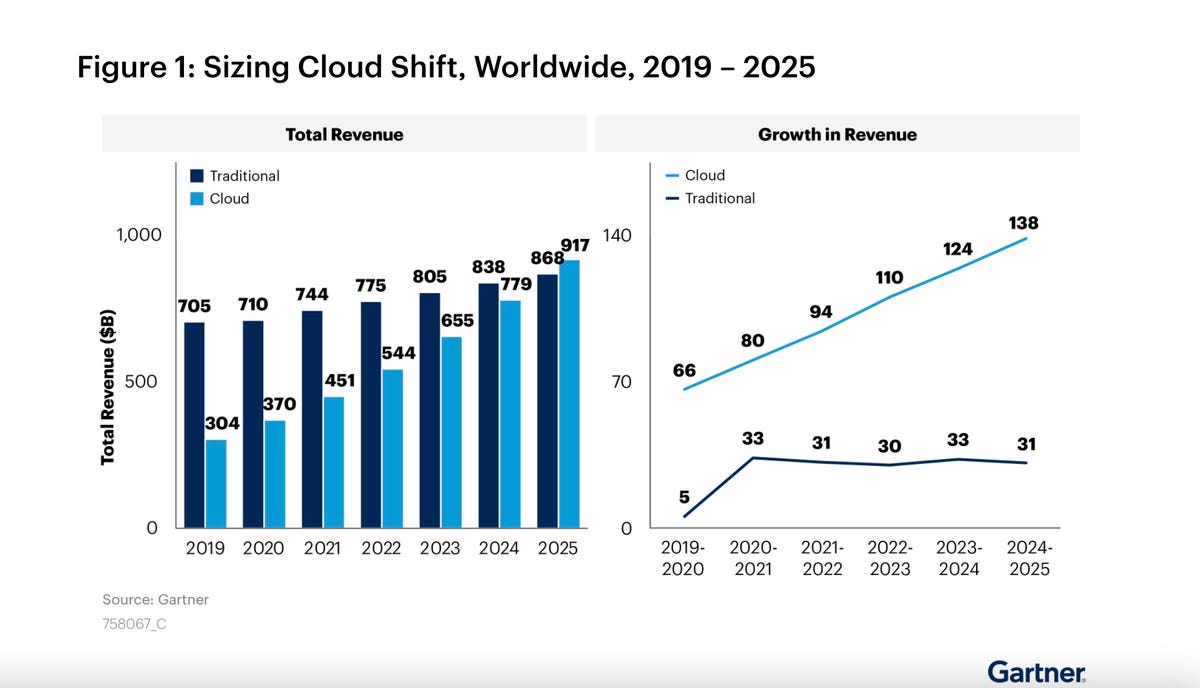
That'southward a shift that simply gained momentum in 2020 and 2021 every bit businesses accelerated their digital transformation plans during the pandemic. The lockdowns throughout the pandemic showed companies how of import it was to be able to access their computing infrastructure, applications and data from wherever their staff were working – and not just from an office.
Gartner said that demand for integration capabilities, agile work processes and composable compages will bulldoze the continued shift to the cloud.
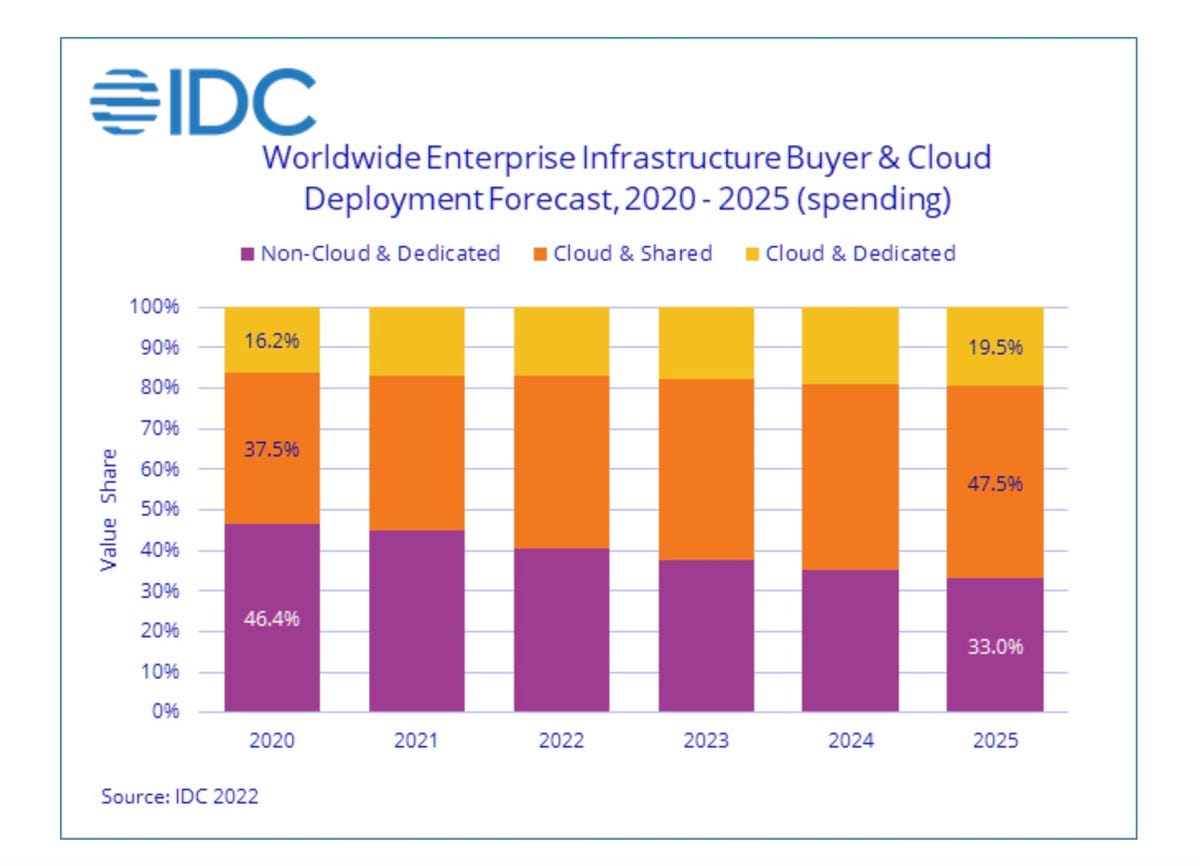
The scale of deject spending continues to rise. For the full year 2021, tech annotator IDC expects cloud infrastructure spending to have grown 8.3% compared to 2020 to $71.8 billion, while non-deject infrastructure is expected to grow just 1.ix% to $58.4 billion. Long term, the annotator expects spending on compute and storage cloud infrastructure to see a compound annual growth charge per unit of 12.4% over the 2020-2025 flow, reaching $118.viii billion in 2025, and it will account for 67.0% of total compute and storage infrastructure spend. Spending on not-cloud infrastructure will be relatively flat in comparison and attain $58.6 billion in 2025.
All predictions around cloud-computing spending are pointing in the same direction, fifty-fifty if the details are slightly different. The momentum they are describing is the same: tech analyst Canalys reports that worldwide cloud infrastructure services expenditure topped $50 billion in a quarter for the first fourth dimension in Q4 2021. For the full year, it has cloud infrastructure services spending growing 35% to $191.vii billion
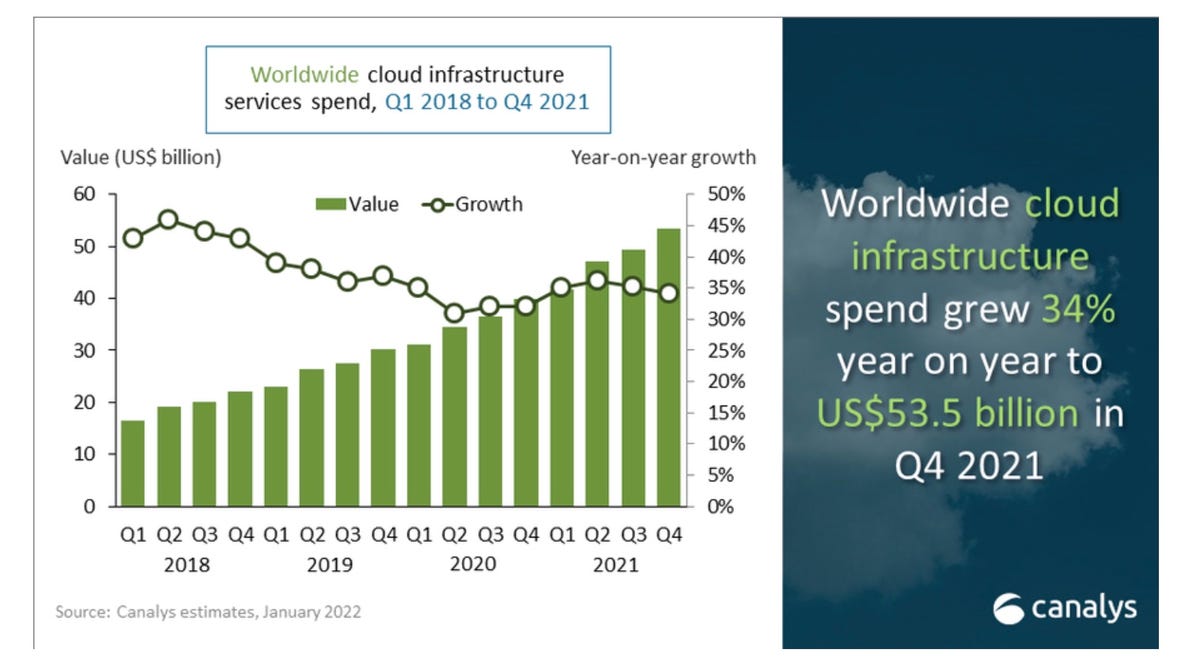
Canalys argues that there is already a new growth opportunity for cloud on the horizon, in the grade of augmented and virtual reality and the metaverse. "This will exist a significant commuter for both cloud services spend and infrastructure deployment over the next decade. In many means, the metaverse will resemble the internet today, with enhanced capabilities and an amplified compute consumption charge per unit," the analyst said.
What are the core elements of cloud calculating?
Deject computing can be broken down into a number of different elective elements, focusing on unlike parts of the technology stack and unlike use cases. Let's take a look at some of the best known in a bit more detail.
What is Infrastructure as a Service?
Infrastructure equally a Service (IaaS) refers to the cardinal building blocks of computing that tin be rented: concrete or virtual servers, storage and networking. This is attractive to companies that want to build applications from the very basis up and want to control nearly all the elements themselves, only it does require firms to have the technical skills to be able to orchestrate services at that level.
What is Platform every bit a Service?
Platform as a Service (PaaS) is the adjacent layer up – as well as the underlying storage, networking, and virtual servers, this layer also includes the tools and software that developers need to build applications on height, which could include middleware, database management, operating systems, and development tools.
What is Software equally a Service?
Software every bit a Service (SaaS) is the delivery of applications as a service, probably the version of cloud calculating that most people are used to on a 24-hour interval-to-solar day basis. The underlying hardware and operating organization is irrelevant to the end user, who will access the service via a web browser or app; information technology is often bought on a per-seat or per-user basis.
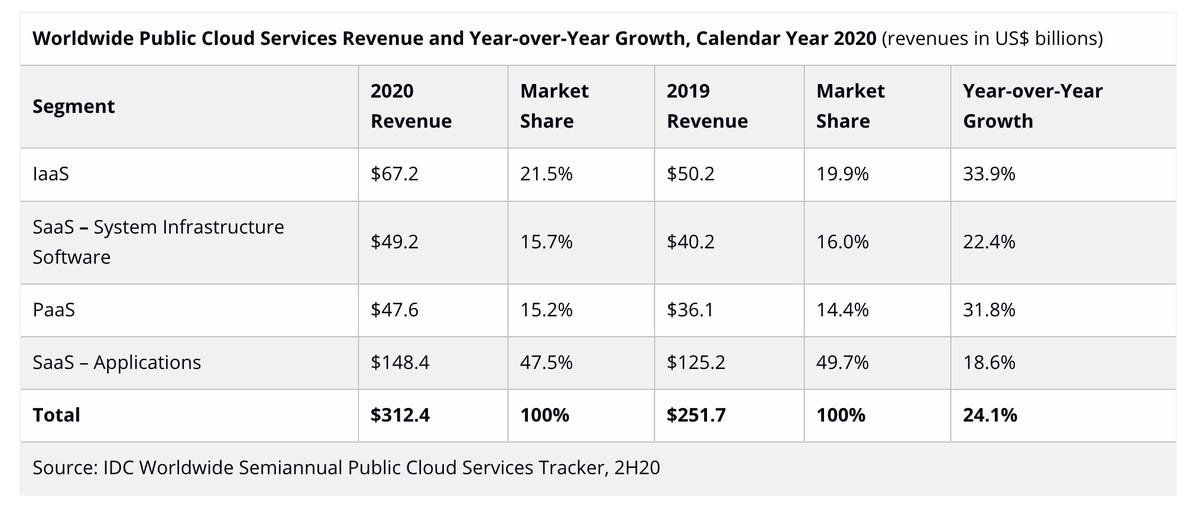
SaaS is the largest chunk of cloud spending only because the variety of applications delivered via SaaS is huge, from CRM such as Salesforce, through to Microsoft's Office 365. And while the whole market is growing at a furious rate, it'due south the IaaS and PaaS segments that have consistently grown at much faster rates, co-ordinate to annotator IDC: "This highlights the increasing reliance of enterprises on a cloud foundation congenital on cloud infrastructure, software-defined data, compute and governance solutions as a Service, and cloud-native platforms for application deployment for enterprise It internal applications." IDC predicts that IaaS and PaaS will go along growing at a higher rate than the overall cloud market "as resilience, flexibility, and agility guide It platform decisions".
What is multi-deject calculating?
While the big cloud vendors would be very happy to provide all the calculating needs of their enterprise customers, increasingly businesses are looking to spread the load beyond a number of suppliers. All of this has pb to the ascension of multi-cloud. Office of this approach is to avert being locked in to just one vendor (which can lead to the sort of loftier costs and inflexibility that the cloud is ofttimes claimed to avoid), and office of it is to find the best mix of technologies across the industry.
That means being able to connect and integrate cloud services from multiple vendors is going to exist a new and increasing challenge for business. Bug here include skills shortages (a lack of workers with expertise across multiple clouds) and workflow differences between cloud environments. Customers will also want to manage all their different deject infrastructure from ane place, brand it easy to build applications and services and and so motility them, and ensure that security tools can piece of work across multiple clouds – none of which is specially easy correct now.
What are the benefits of deject computing?
The verbal benefits volition vary co-ordinate to the type of deject service existence used but, fundamentally, using deject services ways companies not having to buy or maintain their own computing infrastructure.
No more ownership servers, updating applications or operating systems, or decommissioning and disposing of hardware or software when it is out of date, as it is all taken intendance of by the supplier. For commodity applications, such every bit email, it can brand sense to switch to a cloud provider, rather than rely on in-house skills. A visitor that specializes in running and securing these services is probable to have meliorate skills and more experienced staff than a pocket-sized business organization could afford to hire, so cloud services may be able to deliver a more than secure and efficient service to stop users.
Using cloud services means companies can move faster on projects and test out concepts without lengthy procurement and large upfront costs, because firms only pay for the resources they swallow. This concept of business concern agility is often mentioned past cloud advocates equally a key benefit. The power to spin up new services without the time and effort associated with traditional It procurement should mean that it is easier to go going with new applications faster. And if a new application turns out to be wildly popular, the elastic nature of the deject means information technology is easier to scale it up fast.
For a company with an application that has big peaks in usage, such as 1 that is only used at a particular time of the week or yr, it might brand fiscal sense to take it hosted in the cloud, rather than have dedicated hardware and software laying idle for much of the time. Moving to a cloud-hosted application for services like electronic mail or CRM could remove a burden on internal IT staff, and if such applications don't generate much competitive reward, at that place volition exist piffling other impact. Moving to a services model also moves spending from capital expenditure (capex) to operational expenditure (opex), which may be useful for some companies.
- Business continuity is the ultimate killer application for cloud
- It's official: Supercomputing is now ho-hum (cheers, cloud)
What are the advantages and disadvantages of cloud computing?
Cloud computing is non necessarily cheaper than other forms of computing, just equally renting is not always cheaper than buying in the long term. If an awarding has a regular and predictable requirement for calculating services information technology may exist more economical to provide that service in-firm.
Some companies may exist reluctant to host sensitive data in a service that is also used past rivals. Moving to a SaaS awarding may besides mean you are using the same applications as a rival, which might get in difficult to create whatsoever competitive advantage if that application is core to your concern.
While it may exist easy to start using a new cloud application, migrating existing data or apps to the cloud might be much more than complicated and expensive. And it seems in that location is now something of a shortage in cloud skills, with staff with DevOps and multi-cloud monitoring and management knowledge in particularly brusk supply.
In 1 report, a significant proportion of experienced cloud users said they idea upfront migration costs ultimately outweigh the long-term savings created by IaaS.
And of course, you lot tin only access your applications if you have an internet connection.
What is cloud-computing adoption doing to IT budgets?
Cloud computing tends to shift spending from capex to opex, every bit companies buy calculating as a service rather than in the form of physical servers. This may permit companies to avoid large increases in It spending which would traditionally be seen with new projects; using the cloud to make room in the budget might be easier than going to the CFO and looking for more money.
Of course, this doesn't mean that cloud computing is always or necessarily cheaper that keeping applications in-house; for applications with a predictable and stable demand for computing ability, information technology might be cheaper (from a processing power point of view at to the lowest degree) to keep them in-house.
- Cloud computing spending is growing fifty-fifty faster than expected
How do you build a business organisation case for cloud computing?
To build a business case for moving systems to the deject, you lot offset demand to empathize what your existing infrastructure actually costs. At that place's a lot to cistron in: obvious things like the cost of running data centres, and extras such as leased lines. The cost of physical hardware – servers and details of specifications like CPUs, cores and RAM, plus the cost of storage. You'll also need to calculate the cost of applications, whether you lot plan to dump them, re-host them in the cloud unchanged, completely rebuilding them for the cloud, or purchase an entirely new SaaS package. Each of these options will take dissimilar cost implications. The deject business example likewise needs to include people costs (oft 2nd simply to the infrastructure costs) and more nebulous concepts like the benefit of being able to provide new services faster. Any deject business instance should also factor in the potential downsides, including the risk of existence locked into 1 vendor for your tech infrastructure (come across multi-cloud, higher up).
- Deject computing: How to build a business instance
- Deject computing: What it's like to make the move
Deject-computing adoption
Analysts contend that every bit the cloud now underpins most new technological disruptions in everything from mobile banking to healthcare, usage is merely going grow. Information technology's hard to encounter many new technology projects being delivered that don't harness the cloud in some fashion. Gartner says that more than 85% of organizations will embrace a deject-first principle by 2025 and will non exist able to fully execute on their digital strategies without information technology. The analyst says new workloads deployed in a deject-native environment will exist pervasive, not just popular, and anything non-deject will be considered legacy. Past 2025, Gartner estimates that over 95% of new digital workloads volition be deployed on cloud-native platforms, up from 30% in 2021.
And if that sounds unrealistic, it may be that figures on adoption of deject depend on who you lot talk to within an arrangement. Not all cloud spending will be driven centrally by the CIO: cloud services are relatively piece of cake to sign-upwardly for, so concern managers tin can beginning using them, and pay out of their own budget, without needing to inform the IT department. This can enable businesses to move faster, but as well can create security risks if the employ of apps is not managed.
Adoption will also vary by application: deject-based e-mail is much easier to prefer than a new finance system, for example. And for systems such as supply concatenation management, that are working efficiently as they are, there volition exist less short-term pressure to do a potentially costly and risky shift to the cloud.
What most cloud-calculating security?
Many companies remain concerned virtually the security of cloud services, although breaches of security are rare. How secure you consider cloud computing to exist will largely depend on how secure your existing systems are. In-house systems managed by a team with many other things to worry about are probable to be more than leaky than systems monitored by a cloud provider'south engineers defended to protecting that infrastructure.
Notwithstanding, concerns do remain about security, particularly for companies moving their data between many cloud services, which has led to growth in cloud security tools, which monitor data moving to and from the cloud and betwixt cloud platforms. These tools can identify fraudulent use of information in the cloud, unauthorised downloads, and malware. In that location is a financial and performance bear upon, however: these tools can reduce the return on investment of the cloud by five% to x%, and bear on performance by five% to 15%. The country of origin of cloud services is also worrying some organisations (see 'Is geography irrelevant when information technology comes to cloud computing?' beneath)
- Cloud security and IoT are the new peanut butter and jelly
- Azure confidential computing: Microsoft boosts security for cloud data
- Three smart cloud services that tin can assistance keep your business concern more secure
- Deject computing security: This is where yous'll exist spending the money
- Security every bit a Service? We want it, say IT leaders
What is public cloud?
Public deject is the classic cloud-calculating model, where users can access a large pool of computing power over the internet (whether that is IaaS, PaaS, or SaaS). One of the significant benefits here is the ability to chop-chop calibration a service. The deject-computing suppliers have vast amounts of calculating ability, which they share out between a large number of customers – the 'multi-tenant' architecture. Their huge scale means they accept enough spare capacity that they tin easily cope if any detail customer needs more resources, which is why it is often used for less-sensitive applications that demand a varying amount of resource.
What is private cloud?
Private deject allows organizations to do good from some of the advantages of public cloud – but without the concerns most relinquishing command over data and services, because it is tucked away behind the corporate firewall. Companies tin control exactly where their data is being held and tin can build the infrastructure in a mode they want – largely for IaaS or PaaS projects – to give developers access to a pool of computing ability that scales on-demand without putting security at risk. However, that additional security comes at a toll, as few companies volition have the scale of AWS, Microsoft or Google, which means they will not be able to create the same economies of scale. Nevertheless, for companies that crave boosted security, private deject might be a useful stepping rock, helping them to sympathise cloud services or rebuild internal applications for the cloud, before shifting them into the public cloud.
What are the cloud-computing migration costs?
For startups that plan to run all their systems in the cloud, getting started is pretty simple. Simply the majority of companies, it is not and then unproblematic: with existing applications and data, they need to work out which systems are best left running every bit they are, and which to start moving to cloud infrastructure. This is a potentially risky and expensive motility, and migrating to the cloud could cost companies more if they underestimate the scale of such projects.
A survey of 500 businesses that were early cloud adopters constitute that the demand to rewrite applications to optimise them for the cloud was one of the biggest costs, especially if the apps were complex or customised. A 3rd of those surveyed cited high fees for passing data betwixt systems equally a claiming in moving their mission-critical applications. The skills required for migration are both hard and expensive to find – and fifty-fifty when organisations could find the right people, they risked them existence stolen abroad by cloud-computing vendors with deep pockets.
Beyond this, the majority also remained worried about the performance of critical apps, and one in 3 cited this as a reason for non moving some critical applications.
- Deject calculating migration: More expensive and complicated than you thought
- Technology migrations are more painful, and deject isn't making them any easier
- Where does the NAS fit in an increasingly cloud-centric world?
Is geography irrelevant when information technology comes to cloud calculating?
Actually, it turns out that is where the deject really does matter. Geopolitics is forcing significant changes on cloud-computing users and vendors. Firstly, there is the issue of latency: if the application is coming from a information centre on the other side of the planet, or on the other side of a congested network, then you might discover information technology sluggish compared to a local connection. That's the latency problem.
Secondly, at that place is the issue of data sovereignty. Many companies, particularly in Europe, have to worry about where their data is being processed and stored. European companies are worried that, for example, if their customer information is being stored in data centres in the US or (owned past US companies), it could be accessed by US law enforcement. As a result, the large deject vendors have been building out a regional data centre network so that organizations can continue their information in their own region.
Some have gone farther, effectively detatching some of those datacenters from their main business to make it much harder for US government – and others – to demand access to the customer data stored there. The customer data in the information centres is nether the control of an independent company, which acts as a "information trustee", and United states parents cannot access data at the sites without the permission of customers or the data trustee. Expect to see deject vendors opening more information centres around the globe to cater to customers with requirements to keep data in specific locations.
Deject security is another issue; the United kingdom of great britain and northern ireland authorities's cyber security bureau has warned that government agencies demand to consider the country of origin when information technology comes to adding cloud services into their supply bondage. While it was alarm most antivirus software in item, the consequence is the aforementioned for other types of services also.
What is a cloud-calculating region? And what is a cloud-computing availability zone?
Cloud-calculating services are operated from behemothic datacenters around the world. AWS divides this upward by 'regions' and 'availability zones'. Each AWS region is a separate geographic area, similar European union (London) or United states West (Oregon), which AWS and so further subdivides into what information technology calls availability zones (AZs). An AZ is equanimous of one or more than datacenters that are far enough autonomously that in theory a single disaster won't take both offline, but close plenty together for business organisation continuity applications that require rapid failover. Each AZ has multiple cyberspace connections and power connections to multiple grids: AWS has over lxxx AZs.
Google uses a similar model, dividing its cloud-calculating resource into regions that are then subdivided into zones, which include one or more datacenters from which customers can run their services. It currently over viii zones: Google recommends customers deploy applications across multiple zones and regions to help protect against unexpected failures.
Microsoft Azure divides its resources slightly differently. It offers regions that it describes as is a "set up of datacentres deployed within a latency-defined perimeter and connected through a dedicated regional depression-latency network". It besides offers 'geographies' typically containing two or more regions, that tin can be used by customers with specific data-residency and compliance needs "to proceed their data and apps shut". It as well offers availability zones made up of one or more than data centres equipped with independent ability, cooling and networking.
Which are the big cloud-computing companies?
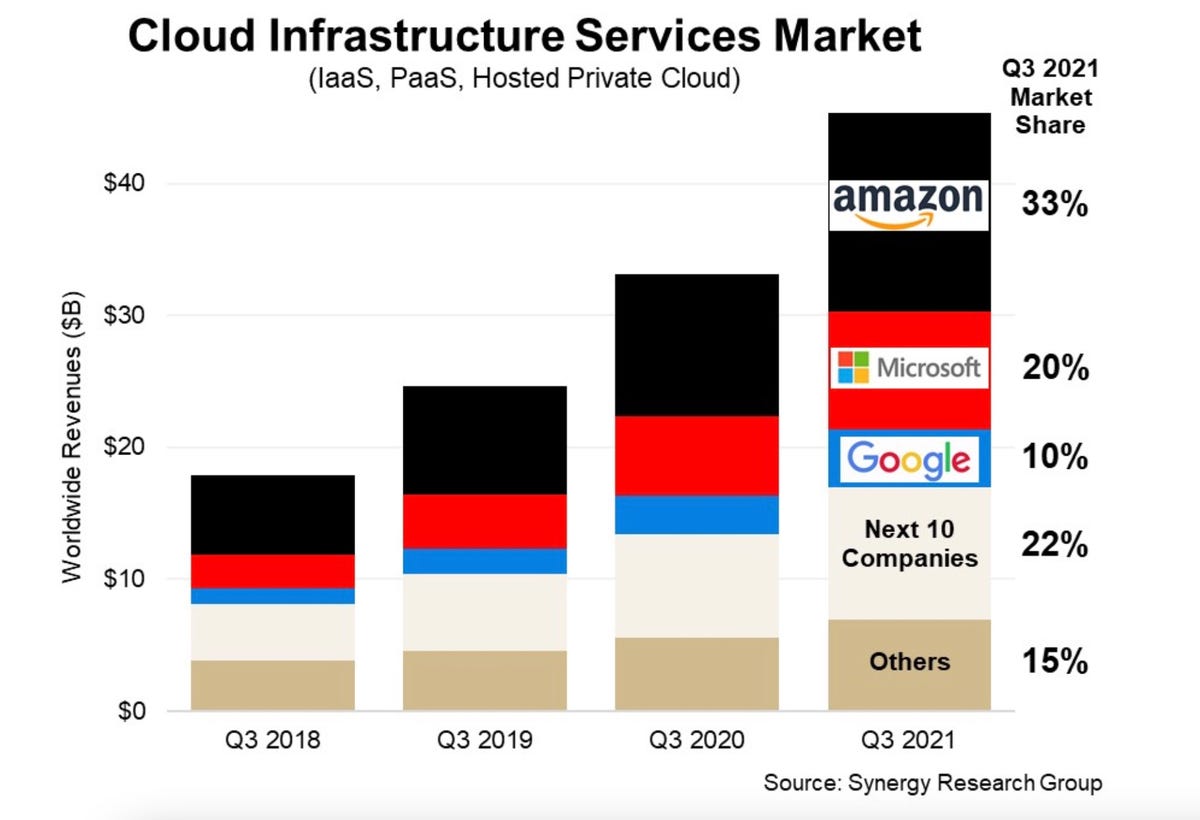
When it comes to IaaS and PaaS, there are really only a few behemothic cloud providers. Leading the way is Amazon Web Services, and then the post-obit pack of Microsoft's Azure, Google, and IBM. According to information from Synergy Research, Amazon, Microsoft and Google continue to attract well over half of worldwide deject spending, with Q3 market shares of 33%, 20% and 10% respectively. And with growth rates that are college than the overall market place, their share of worldwide revenues continues to grow. Notwithstanding, that still leaves plenty of acquirement for the chasing pack of companies – about $17 billion. "Clearly there are challenges with the big three companies lurking in the background, so the proper noun of the game is not competing with them head on," said the annotator.
AWS, Azure and Google Cloud – what'southward the divergence?
The big three cloud companies all have their own strengths. AWS is the most established player and was behind Amazon's ability to support huge seasonal swings in demand from consumers. Existence first out to marketplace with cloud services and pushing hard to proceeds market share has made it the market place leader, and it continues to innovate. Microsoft'southward Azure has become an absolutely core part of Microsoft's strategy, and the company has the enterprise history and products to back up businesses as they switch to the deject. Google Deject is the smallest of the big three players, but conspicuously has the might of the advertising-to-Android giant backside it.
Who are the other primary deject-computing players?
Beyond the big 3 there are others, such equally Alibaba Deject, IBM, Dell and Hewlett Packard Enterprise, that all desire to exist part of the enterprise cloud project. And of course, from giants similar Salesforce downwardly to tiny startups, pretty much every software company is a SaaS company now.
Tin cloud computing get wrong?
There are and volition keep to be cloud outages. Those outages might happen at a local level because your cyberspace is disrupted either by concrete means (a digger cuts your broadband) or because of cyberattacks. But the big vendors have outages too and because, nosotros are all increasingly reliant on their services, when the cloud stops, work stops. Few companies have backup systems to plow to in this situation. So long as cloud vendors proceed outages to a minimum, then users will probably consider that using the cloud is more reliable than habitation-grown apps. Just if outages become widespread, that stance might change.
What is the futurity of cloud computing?
Cloud calculating is reaching the point where it is likely to account for more of enterprise tech spending than the traditional forms of delivering applications and services in-house that take been around for decades. Still, utilise of the deject is merely probable to climb every bit organisations get more comfy with the idea of their information being somewhere other than a server in the basement. And now cloud-computing vendors are increasingly pushing cloud computing as an agent of digital transformation instead of focusing simply on cost. Moving to the cloud tin help companies rethink business organisation processes and advance business change, goes the argument, past helping to break down data whatsoever organisational silos. Some companies that need to heave momentum effectually their digital transformation programmes might find this argument appealing; others may find enthusiasm for the cloud waning as the costs of making the switch add together up.
- Why you're nonetheless scared of the Cloud (it'south non almost security or reliability)
- Cloud computing switch every bit digital transformation takes priority
- Moving to the cloud? Some advice to consider
Deject-computing case studies
There are plenty of examples of organisations deciding to become down the deject-computing route: here are a few examples of recent announcements.
- What's the all-time way to make the virtually of the deject?
- U.s.a. Air Force plots IT overhaul, aims for cloud
- DuluxGroup paints a time to come of procurement in the cloud
- Marketo to migrate to Google Cloud every bit role of multi-year deal
- AWS infrastructure is now behind three main streaming media providers
- American Airlines to move consumer-facing apps to IBM Cloud, says Cloud Foundry cardinal
Previous coverage
The Art of the Hybrid Cloud
Cloud calculating is gobbling up more of the services that power businesses. But, some take privacy, security, and regulatory demands that forbid the public cloud. Here'southward how to find the right mix.
Public cloud, private cloud, or hybrid cloud: What's the divergence?
Trying to sympathise and articulate the differences between public, private, and hybrid cloud? Here's a quick breakup.
Read more on cloud computing
- Three smart cloud services that tin help keep your business organization more secure
- Public cloud, private cloud, or hybrid cloud: What'southward the difference?
- What does 'hybrid cloud' mean? It depends on whom y'all enquire
- Infographic: Companies are turning to hybrid cloud to salvage coin
- Businesses will spend $128 billion on public cloud this twelvemonth, says IDC
- Cloud computing security: This is where you'll be spending the coin
Source: https://www.zdnet.com/article/what-is-cloud-computing-everything-you-need-to-know-about-the-cloud/

Post a Comment for "What Is a Widely Held but Difficult to Achieve Standard of Availability for a System?"