Ocean Themed Fine Arts Projects for High School Students
Thanks, Ocean:
Mixed-media drawings and watercolor pictures were created for a Thanks Ocean project.
Credit: Courtesy of Laurie Invitee
The drawings of ocean plants, as imagined by 5th graders in a Massachusetts summertime programme, had the craziest of adaptations. One pupil even added a life jacket to give a microscopic organism improve buoyancy.
And in upstate New York, a second grader wrote a verse form almost the bounding main:
Oceans, oceans,
And so many creatures,
Then dandy:
Starfish, clownfish, sharks . . .
In a loftier school marine science class in Florida, students recreated the Japanese art of fish printing while they were learning virtually bony fish such as angelfish, tuna, and salmon.
What do the teachers in these classes have in common? They all feel it is fundamental to blend the arts with lessons on the sea. Integrating the mystery of the ocean with writing, painting, and drawing, they believe, creates a learning experience that helps spark their students' interest in science and besides taps into their imaginations. Melding art and marine studies also offers a way to slip in instruction on both these subjects. Art tends to become pushed aside in favor of NCLB-tested subjects, and ocean studies oftentimes gets overlooked for more familiar science topics.
At a loftier school forth the Florida Keys, marine science instructor Carmen Kelley finds that giving science students easily-on activities, such as art projects, not simply breaks upwards the monotony of a lecture but also taps into right-encephalon, creative thinking rather than just left-brain, analytical thinking.
"You can't teach to one mode. Why do we teach only to the left brain? Using art is just a way of helping some kids with how they acquire best," says Kelley, who likewise teaches art at Coral Shores Loftier Schoolhouse, in Tavernier, Florida. "There has to be a intermission in the design that gets the students to movement effectually."
During a unit on bony fish, Kelley teaches her eleventh and 12th graders nigh gyotaku, a class of fish press that Japanese fisherman used about a hundred years ago. Kelley has her students put various colored inks on dead fish, commonly allurement fish. And so, they identify T-shirts onto the fish to create imprints. Kelley also has her students create journals and illustrations to back-trail other marine lessons.
"Non everybody learns the same fashion," Kelley explains. "Fine art can springboard into retentiveness what students run across in a volume. "
The Practical Side
Belinda Ringpfeil, who teaches gifted students in grades three-6 at Elsanor Simple School, in Robertsdale, Alabama, finds that the art projects she assigns help her students process data and apply what they've learned. She notes that the whole time they're working on an fine art projection, her students are thinking nearly the animal or found.
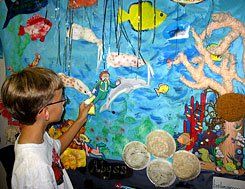
Credit: Courtesy of Belinda Ringpfeil
Underwater Risk: Reid, an Elsanor Uncomplicated Schoolhouse fifth grader, pretends to exist a scuba diver exploring the coral reefs.
One of the projects she uses in class is a three-dimensional model of coral reefs made out of egg cartons and adorned with papier mâché sea animals. The reef model fifty-fifty features retractable tentacles -- some corals accept tentacles to grab food such as zooplankton -- to reverberate the truthful behavior of alive coral.
Although the benefits of using art to enhance ocean science are many, sea studies aren't a big part of school curriculums. A 2004 study by the U.Southward. Commission on Sea Policy found that statewide science standards typically don't call for using marine life to meet scientific discipline requirements. Simply the same written report said core science principles are "easier to grasp when introduced through body of water examples," and information technology urged the cosmos of ocean curriculums that more Chiliad-12 teachers can use.
Educators who use ocean-studies lessons believe information technology is a shame not to incorporate the subject field in lessons. "The body of water is so massive, and nosotros take then many connections to it," says Ringpfeil. "I think it's pretty ridiculous to raise our students to ignore information technology and not learn about it."
Some science teachers practise use the body of water to teach basic science concepts that are function of science standards, such as the food chain. Laurie Guest, who teaches sixth- and seventh-grade scientific discipline at the Mare Isle Engineering science Academy, in Vallejo, California, uses the body of water to meet standards on photosynthesis and ecology. Her students have a natural love of animals and the bounding main, which she plays to in her lessons. "The real hook in middle school is to find something the kids are interested in," Guest says. "Plus, studying about the sea fits beautifully into the standards."
Mixing Subjects
Ringpfeil uses the sea in writing assignments to tap into higher-level imaginative thinking. A lot of children, she says, don't know how to apply their imagination, then her assignments ask them to choose a bounding main brute and write from the perspective of that brute. They go meliorate creative writers, she says, as they pretend to be the animals, imagining what they practice and where they get.
In Angola, New York, along Lake Erie but 400 miles from the bounding main, reading specialist Kathy Dole uses the sea to inspire creativity. Her kids at John T. Waugh Simple School write unlike types of poetry, including question poems that ponder where a seashell came from or why sea turtles eat grass. (Download a PDF of a worksheet and a PDF of the lesson programme she uses.)
For her classroom writing lessons, Dole uses footage of her own scuba-diving trips and shows her students seashells and other objects. "They write almost the beauty that they're seeing," she explains. And when they get to hold an object such as a seashell, they get a sensory experience that makes their writing more interesting. Dole says, "It stimulates their marvel more, and they enquire more questions once they've touched objects from the ocean."
Dole and other teachers who utilize lessons on marine scientific discipline hope to inspire students to take intendance of the oceans while simultaneously helping them improve their academic skills. Recently, a second grader named Victoria approached Dole and told her she had an bounding main story. Dole got out a pencil and wrote information technology downwardly:
"Y'all always have to keep the beach clean. Keep the sand clean, or you lot'll stride on something sharp and pause your foot open up. Always brand certain no dead bones are on the beach, or people could pick them up and think they're doggie toys. Practise not kill many fish in the ocean, considering soon there won't be whatsoever. If you do, then you won't be a part of the Big Green Help."
Dole plans to use this story to help Victoria with her reading and writing.
Alexandra R. Moses is a freelance writer in the Washington, DC, area who specializes in education.
Get to "How To: Teach the Sea from the State."
Source: https://www.edutopia.org/marine-science-art-integrated-studies

Post a Comment for "Ocean Themed Fine Arts Projects for High School Students"