You Made Me Live Again Solo Guitar Pdf Scribd
You and I are not that dissimilar. We both want to go better jazz improvisers. We both have a passion for jazz music and we fantasize nearly taking killer solos the next time we go to play.
But tell me if you tin can chronicle to any of these common issues I hear from my students, listeners, and subscribers:
1. You experience overwhelmed past the vast amount of jazz teaching info out there.
2. Considering of that, you lot simply don't know where to start.
3. You're not exactly sure what stuff you should be practicing to motion the needle.
iv. You accept some experience already, but yous feel stuck and aren't improving.
v. Y'all feel like your progress is boring going.
 Listen I get information technology. I've been at that place more than than once.
When I beginning started studying jazz, it was my senior year of high school. Some would call that starting tardily, others wish they had started that young.
Either mode, I was struggling to keep upwardly. I wanted and so badly to sound like my more experienced friends and my jazz heroes.
I'll fast-forward, though, and skip the details.
I now brand my living equally a jazz musician. I've published music books for a big visitor and cocky-publish my own. I play gigs here in New York, teach courses, and run my renowned jazz education blog and podcast.
It doesn't matter if yous don't accept the aforementioned aspirations as me. You may be a hobbyist (sometimes I green-eyed you). But what I practice know is that you want to improve, merely like I practice.
The secret is I learned how to practice in a goal-oriented, focused mode, working on the right things with an activity programme.That's exactly what I want to teach you.
I want to take away the guesswork and make jazz improvisation simple for you.
Here'southward what I'll cover in this post:
I'll start from the beginning, merely your can click whatever of these links to skip ahead.
i. Common Myths Most Playing Jazz.
2. Step #one: Setting Up Your Jazz Practice Sessions for Success
3. Step #2: "The Large 3" Things You lot Need to Practice to Improve as a Jazz Improviser
4. My Listing Process for Learning Jazz Language By Ear
five. Pace #3: Creating an Action Plan for Quicker Jazz Improvement
vi. The Stair-Footstep Practice Program
7. Conclusion
I also go over everything in this post in farther detail in my free video mini-course chosen "Accelerate Your Jazz Skills." Then if yous want to swoop in a bit farther, click the link or the logo beneath, sign up, and I'll send you lot the first video right away.
 Are you lot ready for this? Allow's practise information technology!
Common Myths About Playing Jazz
Start things outset. We need to debunk some myths about playing jazz. I've heard them all, and if we desire to become great jazz improvisers nosotros need to get rid of some of these limiting beliefs.
 Myth #1: Jazz is only for the exceptionally talented.
Wrong. I sympathize that musicians coming from other genre backgrounds sometimes expect at jazz and go overwhelmed.
Yeah, jazz may be more circuitous than some other styles of music. Merely that doesn't hateful that someone with average talent tin't acquire how to play information technology.
I don't consider myself "exceptionally talented," but I've been able to reach a higher level of playing by doing the things I will be talking about in this post.
Myth #ii: You need to larn a bunch of fancy scales.
Faux. Don't get me wrong, scales have their place in our jazz education, particularly when it comes to knowing your instrument. A petty scrap of chord/scale theory doesn't injure either.
Only jazz improvisation is not about scales. Jazz is well-nigh learning a language (more than on that shortly). Don't worry then much about which calibration to play over this chord or that chord.
Myth #3: Yous need to know a lot of music theory.
I think this 1 is way over exaggerated. Sure, knowing music theory helps. Indeed, you should know some theory basics like how to build chords, or how chord progressions work.
But y'all don't demand to know a lot. You don't need to know every melodic pocket-size application and every fancy term. Past doing the things I talk about in this post you can larn as you go forth.
Myth #4: If you lot but mind and keep playing, yous'll eventually go it.
Don't you but hate it when people say that? That's simply frustrating.
Of class you demand to listen, and of course, you need to exercise.
But if yous don't have guidance, if you lot aren't practicing the correct things, and if you don't have an activeness plan, it's going to be a real uphill boxing.
Myth #v: The more hours you practise the better yous volition go.
Fake. I've wasted hundreds of hours of my precious time practicing.
I've wasted time learning stuff that had nothing to do with what I practiced the day earlier. I've wasted time simply noodling and not actually practicing anything. I've wasted time not having an activeness plan.
Information technology is true that the more you practice the more opportunity you have to improve. Just under the right circumstances, it is quite possible to get more out of a 30-infinitesimal practice session than a 5 hour one.
If you're more than of a visual learner, hither's a video where I sum up all of these myths:
Step #one: Setting Upward Your Jazz Practice Sessions for Success
After all of those myths, here's a piece of solid truth:
Becoming a better jazz improviser comes down to how and what you do. Non learning fancy tricks.
But I don't remember I have to convince you of this. I mean, if you want to become a great chef, what do you have to do? Cook a lot. There aren't any magic potions to potable or special prayers to recite.
It'southward the aforementioned with jazz. The more yous listen to it, practice it, and go out and play it, the ameliorate y'all will become.
Now, it goes without saying that you need to be listening to jazz. If y'all aren't listening to the music you'll never quite sympathise it. Simply I don't need to tell you that.
So where practise we kickoff?

There are those that laugh off this first pace. That'southward their mistake. Luckily, you and I understand this is important.
When setting off to better as a jazz improviser we need to showtime set Primary Goals.
What's a Primary Goal?
A Primary Goal is your big-picture vision of where y'all want to be in your jazz performance. This big-picture show vision has everything to practise with why yous wanted to study jazz in the first identify.
And so why is this important?
Considering if you don't know what you are working towards, information technology's going to be easy to lose your focus, discard your activeness plan, and lose your motivation. It's similar anything else in life.
When coming upwards with your Master Goal, effort to think of a transformation.
Here's an example of a bad Main Goal:
"I want to larn l jazz standards."
What'south missing in this goal is a transformation. Why do you want to learn 50 jazz standards? What would that accomplish? Simply doing tasks will non be plenty.
Here'south an example of a expert Primary Goal:
"I desire to feel comfy playing at my local jazz jam session."
Now that'southward a transformation. Perhaps someone setting this goal is a beginner and wants to go from watching in the back to playing on stage. Now they know why they want to put in the piece of work of learning a few jazz standards.
Here's another i:
"I want other musicians to starting time calling me for gigs."
This is the next level up compared to the final case. Maybe this musician feels comfortable playing at her local jazz jam and even has some gigs of her ain.
But she wants to exist good enough that others are calling HER for the gigs. That's a transformation. From being the one calling to being called. That's something with real value to piece of work towards.
So here's what I want you lot to exercise right now:
Grab a slice of paper (I prefer post-it notes), recall hard about it, and write down your Main Goal.
No, I mean it! Don't be self-conscious, just do it. Then put information technology up where you practice so you can exist reminded of it.
Did you practice it? Good. Let'southward move on to the next step.
Stride #2: "The Large 3" Things You Demand to Practice to Ameliorate as a Jazz Improviser
Once you lot have your Master Goal established, how practise you get nearly accomplishing it? Neat question. Let's get it answered.
I've likewise done a podcast episode on this too. So if you prefer to heed, hither information technology is.
As I mentioned at the beginning of this post, a common struggle people have is being overwhelmed by the sheer corporeality of material floating around on the internet.
I mean there's YouTube, podcasts, books, courses, and blogs like this one, all telling you a 1000000 dissimilar things to work on in no particular order.
It's all well and skillful, simply information technology as well tin be a rabbit hole to going nowhere.
In comes "The Large iii."
 I'm going to help you lot get rid of all of the ataxia and brand things elementary for yous. If you want to improve as a jazz improviser you need to exist working on these iii categories.
Information technology'south not just me who thinks so. I've had the opportunity to report with some pretty big deal jazz musicians, and I've gotten these from them. I've just packaged them nicely.
I can almost guarantee, if y'all practise these things consistently, you will accomplish your jazz performance goals.
1. Technique.
Have you lot ever seen a sushi chef slicing up tuna or etching out cucumber garnishes? Their knife skills are absolutely amazing. Clearly, they've spent a adept amount of fourth dimension honing their craft.
I'm more than a fan of French cooking, and so here's a quote from a great French chef:

"I certainly don't cook the same way I did 40 years ago, but the technique remains. And that'due south what the pupil needs to learn: the technique."
-Jacques Pepin
In other words, you demand to know your instrument and be able to navigate information technology. Yous can't just start improvising without a foundation underneath you.
Here's a quote from a guy more up our alley:
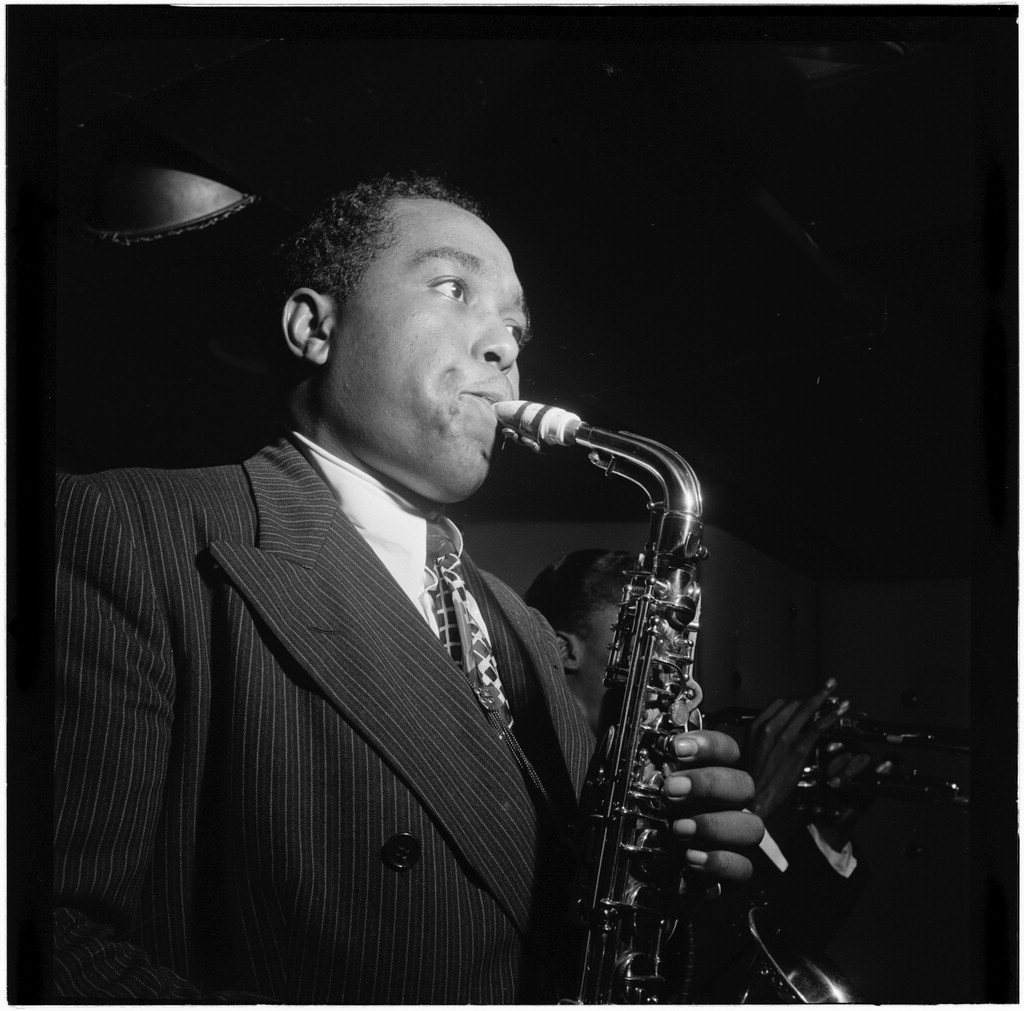
"You've got to acquire your instrument. Then, you practice, practice, do. And then, when you finally get up there on the bandstand, forget all of that and just wail."
-Charlie Parker
I similar the function about forgetting information technology all and merely wailing. But notice the starting time thing he said: "You've got to larn your instrument."
If we desire to exist proficient jazz improvisers, we can't have things belongings us back. Therefore nosotros need to piece of work on technique.
Technique doesn't necessarily have anything to do with jazz, but improvising requires flexibility.
So what should you be working on when it comes to technique?
-
Instrument Specific Stuff
Each instrument has its own sets of challenges.
I'm not a trumpet actor, just I know from some of my friends that working on long tones is of import.
As a guitar player, I don't need to piece of work on long tones. I need to be working on playing things in different positions on the fretboard.
If yous don't know what instrument specific technical exercises you should work on, be sure to ask a teacher of your musical instrument.
-
The Nuts (scales, arpeggios)
Make sure you know your basic scales. If you already know them, there is no impairment in warming upward with them from time-to-time, and playing them in different keys.
I don't necessarily recall you need to know every scale ever invented, only at least know the basics. Hither are a few:
Major Scale
 Natural Small Scale

Harmonic Modest Scale

Melodic Minor Scale

I besides retrieve that it's important to know the Modes of the Major Scale. These can actually help you start to understand scales more every bit "pitch collections" rather than things to play verbatim.
Here'south simply one example:
Mixolydian Style

Likewise, brand sure y'all know arpeggios of bones triads and 7th chord qualities. I prefer calling them chord tones.
Make certain you know their formulas and then effort making fun exercises out of them like this one:
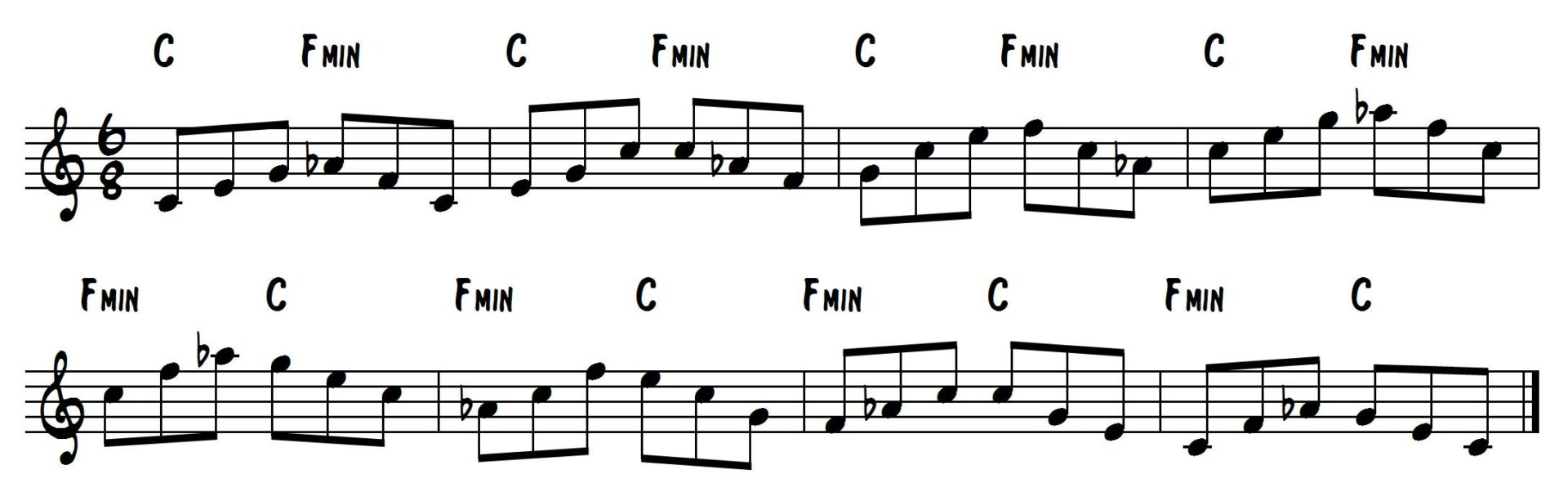 In this exercise, I'm using two random major and minor triads and simply connecting them together past the nearest chord tone. I exercise a lot of these kinds of exercises in my volume Zero to Improv.
-
Pattern Exercises
Patterns are great for all kinds of instrumentalists to practice.
They assist y'all develop flexibility on your instrument so that your fingers tin can motility in ways they may not exist used to.
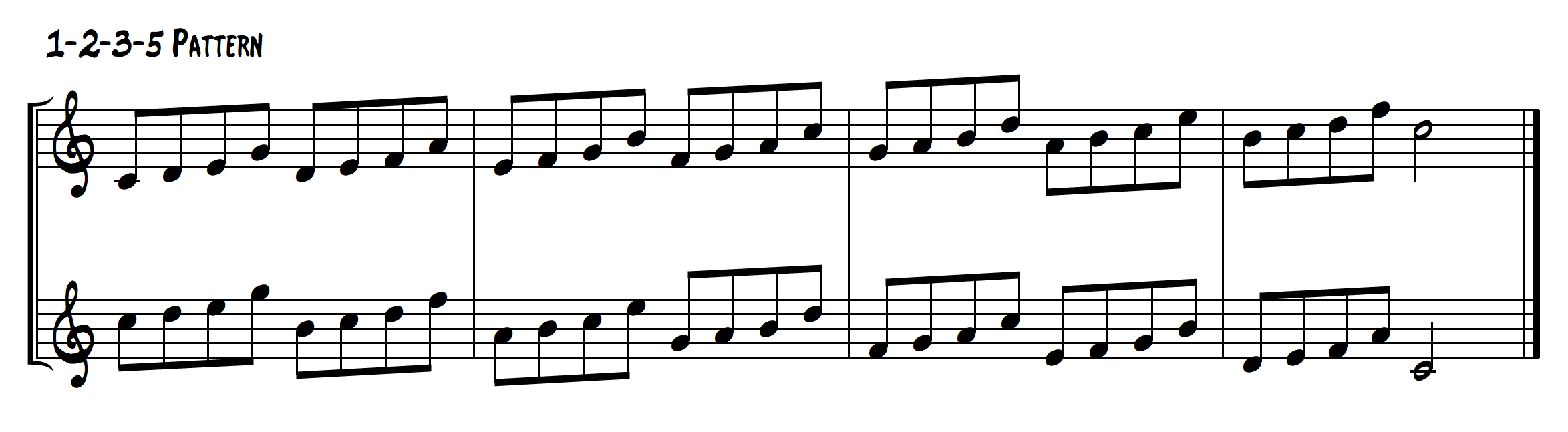
Here'southward an instance of 1 to try:
At present, you might exist thinking, "Brent, this is actually a lot of stuff!"
Don't worry, don't go overwhelmed. You don't need to exercise everything at once. Simply pick 1 small-scale affair to do in your practise session.
That'southward information technology.
This is also where having an activity plan comes in, which we'll talk almost later.
Technique is actually important. Brand certain you are working on it at least a picayune bit when you practice.
Let's move on to #two of the Big 3.
two. Jazz Repertoire.
I'thou going to stick with cooking equally an example. I recently got a Julia Child book called "Mastering the Art of French Cooking."
Around my house, I do a lot of the cooking for me and my wife since I work mostly from home. Over time, I've adult a repertoire of dishes I'm good at making.
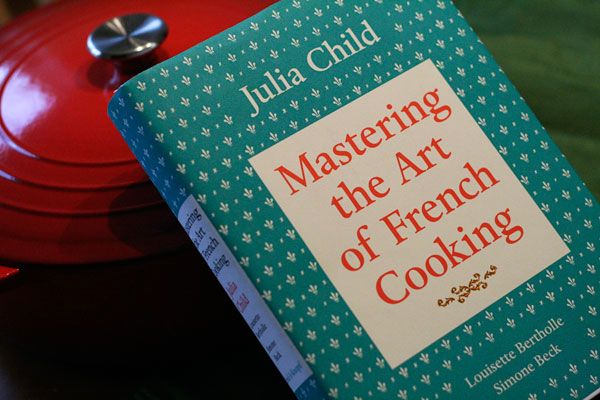
I use books similar this one to help me learn new recipes. Remember about information technology: how tin can I exist a home chef if I don't know whatever recipes? I need to have a repertoire of dishes I can brand.
I've studied a chip with one of my favorite jazz guitarists, the peachy Peter Bernstein.
I once asked him what kinds of things he used to practice to develop equally a jazz musician when he was younger.
This is what he told me:
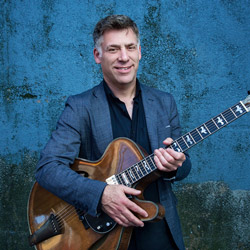
"I allow the tunes teach me how to play."
-Peter Bernstein
And then simple. If you desire to become a nifty jazz improviser, just learn jazz standards.
Jazz standards are the vehicles in which jazz musicians use to improvise and communicate with each other.
All of the of import lessons about harmony and navigating chord changes tin be plant in these tunes.
Even if y'all like composing a lot of your ain music, learning jazz standards are essential for understanding the history and tradition of this music. You'll become a amend composer for it also.
So should a big part of our jazz studies include learning jazz standards? Absolutely.
So which jazz standards should you exist learning?
At that place are hundreds upon hundreds of them, and quite frankly it can be overwhelming and difficult to know where to commencement.
I always like to suggest what I call my "Principal Jazz Standards."
It's a unproblematic list of 10 jazz standards that non only are commonly called upon to play simply have some valuable lessons to teach united states. Here they are:
1. Autumn Leaves: Very common, and is an excellent written report of major and small-scale ii-Five-I chord progressions.
two. Blue Bossa: Common starter tune. Not bad for an introduction to pocket-size harmony.
3. All of Me: Classic jazz standard. Tin can't get away with not knowing it.
4. Information technology Could Happen to Y'all: Keen study of diatonic harmony in general.
5. Sweet Georgia Brown: Excellent study of cycling dominant 7th chords.
6. So What: The virtually basic introduction to modal harmony.
7. On Green Dolphin Street: Classic. Written report of irresolute central centers up a small 3rd.
8. Accept Yous Met Miss Jones: The bridge is a great study of cardinal center changes.
9. All the Things You Are: First-class written report of chords cycling in 4ths (common).
x. Stella Past Starlight: A fairly hard song, simply super commonly called upon.
If you learn all of these jazz standards, I tin almost guarantee that only about every other jazz standard y'all will learn after will exist 10X easier. I even wrote an entire book on studying and understanding these 10 jazz standards.
I would also advise learning how to play a jazz blues, and learn multiple heads. Tenor Madness is a skillful example. In fact, if you are a complete beginner, this is a great identify to offset.
Rhythm changes is an important song form to know as well, especially when it comes to playing in the bebop fashion. Oleo is a adept instance.
So you know yous should be learning jazz standards, just how practise yous learn them?
Dandy question, but bear with me just a little bit longer. I'yard going to go over that right afterwards nosotros finish with the tertiary and terminal category of The Big 3.
3. Jazz language.
I can't resist. I have to go with another cooking example.
I mentioned that I take developed a repertoire of dishes I tin cook. Well, the truth is, most of them I don't really have to read a recipe for anymore.
You see, I've fabricated them enough times and I've copied plenty different versions of the same dish, that I've developed my own way of making them.
But to do that I've had to steal culinary ideas and techniques from other chefs. The aforementioned way I've stolen musical ideas from other musicians.

I know, this sounds bad. Merely trust me, I don't mean stealing in a bad way.
In fact, stealing probably isn't the right word for it. Because at the finish of the day, learning jazz (or any style of music) is like learning a language.
In club to learn a language, we need to mimic native speakers.
Call up nigh it. When you were a little kid, that'due south exactly how y'all learned to speak your native language. By mimicking your parents.
We have to do the same when learning to become jazz improvisers. Nosotros need to learn phrases and ideas from great jazz musicians so that later those ideas can evolve. Through this learning process, we tin can then develop our own way of playing.
So what kinds of jazz language should we learn?
I like to interruption it down into ii unlike categories: micro linguistic communication and macro language.
-
Micro linguistic communication: Licks
Licks are minor musical phrases, usually over a particular chord or chord progression.
Licks are great to larn because they can help y'all understand more detailed elements of jazz harmony, such as chord progressions.
Here's an case of a lick I "stole" from Jim Hall:
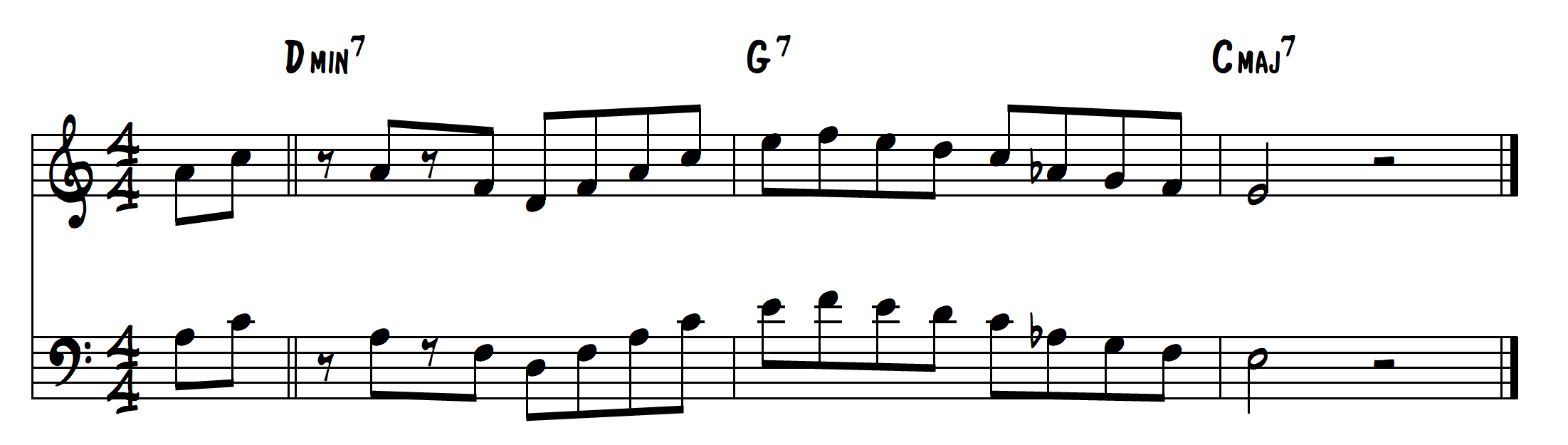
Information technology's over a ii-V-I chord progression, which is the nigh common chord progression in jazz harmony.
By learning Jim Hall's lick, I've been given insight into how he approached this progression and can clarify it further.
-
Macro language: Solos
Learning entire jazz solos is a great style to get inside a macro approach of how an artist approached a jazz standard.
Every time I've done this it has been totally worth the time investment.
I suggest learning jazz solos that you really love, and ones that are accessible to you. What I mean are ones that are inside your skill level and won't be overly difficult.
For beginners (or anyone) I similar to suggest Miles Davis' solo on Freddie Freeloader (a blues).
So how should you learn jazz licks and solos?
By ear.
Preferably not with sail music. I know there are some people who disagree with me, but there are a multitude of reasons why, when it comes to learning jazz linguistic communication, you should practise it by ear.
Here are a few quick reasons:
1. You will internalize it ameliorate. Repetition builds retentivity.
2. You will build your ear. Your ear is your virtually powerful asset in jazz improv.
3. Trains you for reaction. Reading music is a different mindset.
All in all, I highly encourage you to go through the work of learning jazz linguistic communication (and jazz standards) by ear. It will pay dividends.
I know what yous're thinking now.
It begs the question: How do I acquire jazz linguistic communication by ear?
I've got you covered.
My LIST Procedure for Learning Jazz Linguistic communication past Ear
Whether it be jazz standards, licks, or solos, learning them past ear can be challenging if not done correctly.
In comes my List process for learning jazz language. It'due south an acronym and I'll get over it in just ane 2d.
Simply if you'd like a printable pdf for the Listing procedure that you tin hold on to, get myfree eGuide Larn Jazz Standards the Smart Manner.
It'due south completely free, sign up at the link and I'll send information technology to yous right away. I also include a bonus step.
Heed.
The first step in the process is fairly unproblematic: listen to the jazz standard, solo or lick.
That may seem like an obvious outset move, but you would be surprised how many students rush into learning a piece of music with having barely listened to it.
The most important affair y'all tin do when learning jazz language is to put your instrument away and just listen.
Find as many recordings every bit possible of the jazz standard yous want to larn and go through all of them. If it'southward a jazz solo, accept that thing looping on repeat.
You need to become acquainted with the textile, and without becoming acquainted with it first, you lot will have started off on the incorrect foot.
Internalize.
This stride involves more listening, but a different kind: intentional listening.
What practice I mean by that?
Imagine you are sitting in your living room watching a movie. As long as it'southward engaging enough for your tastes, information technology's likely you will sit down yet, optics trained on the screen for two hours or more than.
What if yous treated music in the aforementioned way yous did the movie?
In full general, it's a great practice to mind to music and requite it your full attention, no distractions. Simply this is particularly of import to spend time doing when you are trying to learn new jazz language.
If you requite that song, solo, or lick your full attending, you will brainstorm to internalize it, and it will start to sink into your subconscious.
Sing.
This next step is really important. Singing is a powerful manner to prove that yous have actually internalized the information you are hearing.
No, you don't have to exist a great singer, and sure, if yous want, you can whistle or hum.
When it comes to jazz standards, the primary application of singing involves the melody. Be sure that you can sing the melody of the standard, both along with the recording and on your ain earlier you lot learn it on your instrument.
If you're learning a solo, this is particularly of import.
What singing does is it takes away 50% of the learning process. It proves you lot accept internalized it and all that is left is transferring that musical information to your instrument.
Transfer.
At present it's time to actually pick up your instrument (you shouldn't have been touching it until now).
Y'all should be quite familiar with the vocal or solo and have at least a grasp on the chord changes depending on where you are at in your musical abilities.
If y'all're learning a jazz standard:
1. Transfer the tune. Start learning the melody on your musical instrument. Again, this should only be a matter of you taking what you can already sing and finding the notes on your musical instrument.
2. Acquire the chords. This is the about challenging role of learning songs by ear, but I encourage you to practice your best! It is incredibly helpful to have a good understanding of how jazz harmony works.
At present, if learning chord progressions by ear is brand new to you and you lot become stumped, that's okay.
This would and then be a adept time to take a await at the sheet music. But when you do, become through it while listening to a recording, starting and stopping when appropriate to see if you can decipher what'southward going on by ear.
You may be thinking: "Brent, that's too much work!"
Not really. A lot of this stuff you can do on your commutes, runs, or while you're at the gym. 50% of it is only listening.
Besides, wouldn't information technology be worth following the Listing procedure if it helped yous learn jazz language really well the beginning time? Of class it would.
If y'all'd like to review what I talked about with this process, here'southward a cracking video summary every bit it pertains to jazz standards:
Step #3: Creating an Action Program for Quicker Jazz Improvement
Okay, earlier we movement on, let's recap what nosotros've learned then far:
- Set Master Goals.
- Practice "The Big 3."
- How to larn jazz language by ear (how to do The Big three).
But allow me exist very clear:
None of this matters unless we create an action plan.

This is where many people neglect, and I'll admit, I've been 1 of them.
You may know your big film vision of where you desire to be as a jazz improviser, and you may understand what yous demand to exercise to get in that location.
But without a focused, goal-oriented action-plan, y'all could exist wasting tons of your time, and even money.
So with our Main Goals and The Large 3 in mind, how practise we create an activity plan for jazz success?
First, nosotros demand to empathise three other kinds of goals:
1. Project Goals.
Project goals are exactly what they audio like. You establish a project you want to accomplish.
We'll pick a category from The Big 3: jazz language.
Let's say our projection goal is to learn one jazz solo. Sounds like a adept project right?
Permit's too say that this solo is 4 choruses long and has a 32 bar form.
Awesome, merely that's way too much to bite off all at one time. Even just the idea of learning a 4 chorus jazz solo is overwhelming.
We have to interruption it downwardly even further.
2. Short-Term Goals.
A Brusque-Term Goal breaks down your Project Goal into smaller pieces.
It's similar a pizza. When information technology comes out of the oven it's this massive, cute, pipe hot circle of cheesy goodness. You want to consume it, merely it's simply likewise big to pick up and eat like that. You demand to make information technology smaller.
So let'southward pretend our jazz solo is a pizza (bear with me).
Information technology's four choruses long, so why don't we cut it up into four pieces?
Now we've broken it down into four brusque-term goals of 32 bars. It's now easier to see how we tin accomplish our Project Goal when we practise this.
Simply notwithstanding, 32 bars is a lot to chew on! We demand to break information technology down even further.
3. Micro Goals.
If yous're trying to swallow one-quarter of a pizza all at once, it's a little ridiculous. I mean, yous tin can practice it, but you shouldn't. Information technology's not applied.
How do you fix the problem? Piece information technology upwardly into smaller pieces.
Then if you desire to make your 32 confined easier to assimilate. Learn smaller bits.
I think of Micro Goals on a practice session basis. It is the ammount of new textile you will larn in one practice session.
When it comes to learning solos, I usually advise 4-eight bars. That's not a hard and fast rule. That'south merely normally what a phrase in a jazz solo is. Offset with just the first phrase (a place with a good stopping signal) and just learn that.
This is usually called "batching."
In that location is no need to larn more. In fact, I encourage students in my jazz practicing course 30 Steps to Meliorate Jazz Playing, to simply learn that much in i sitting.
It's the less is more than arroyo, and information technology'south a skillful approach for internalization.
Then your Micro Goals are informed by your Short-Term Goals, and your Short-Term Goals are informed by your Project Goals.
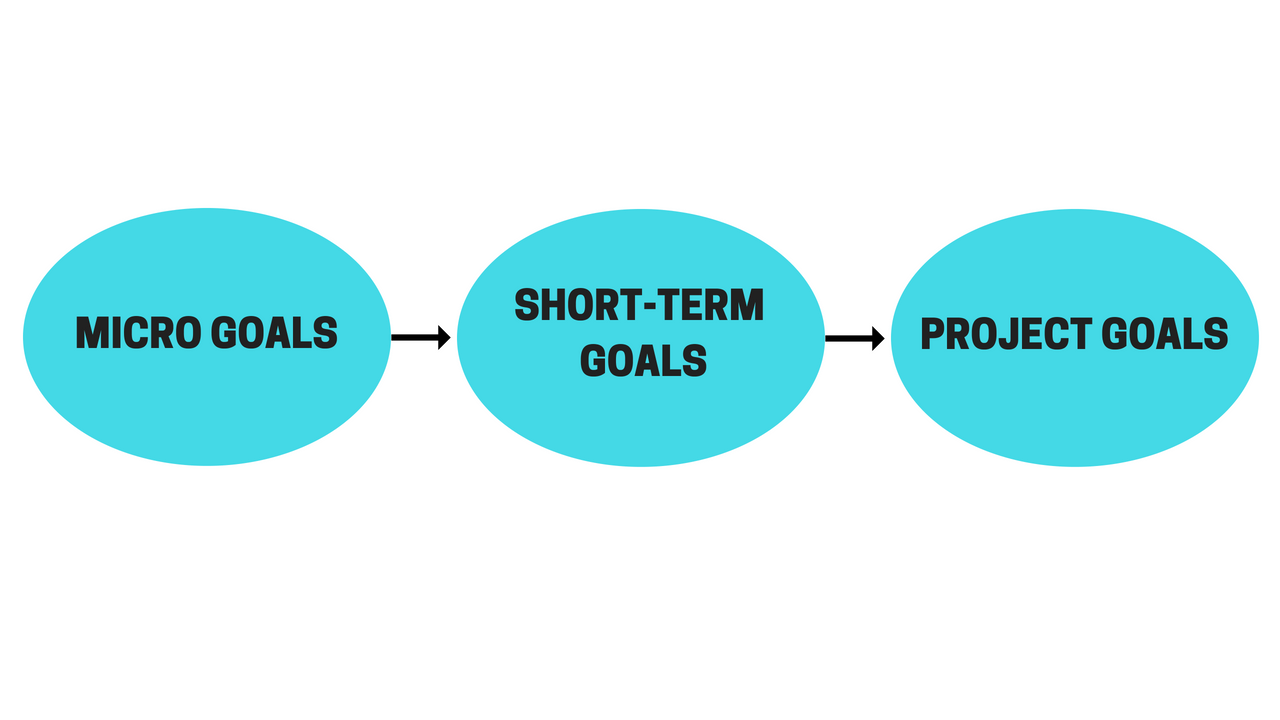
Create a Stair-Step Practice Plan.
To make this fifty-fifty more than understandable, I'm going to testify you lot my Stair-Step Practise Plan.
Yous can use this exact framework to any of The Large three categories and the stuff I've suggested yous practise inside them.
Let'due south continue going with the Project Goal of learning a jazz solo. This time we are going to hone in on how to use Micro-Goals to accomplish our Brusk-Term Goal of 32 bars.
Take a look at the analogy first, and then I'll explain further.
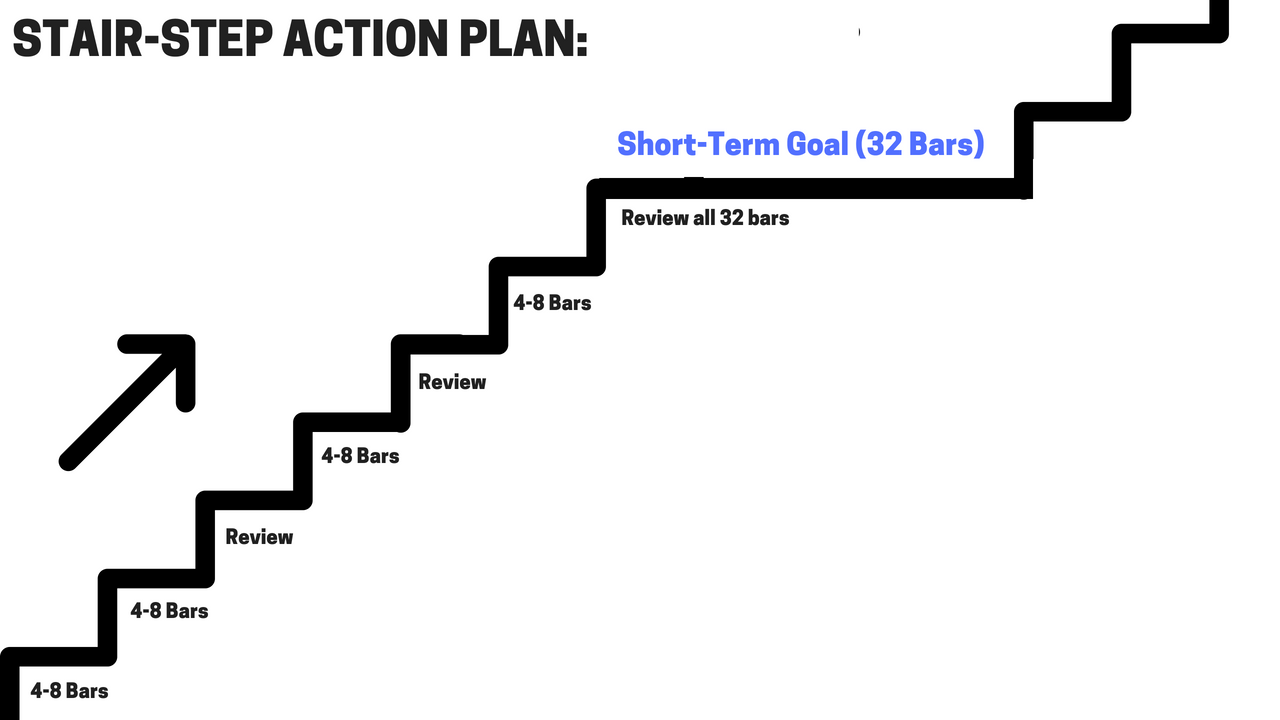
You're looking at a set up of stairs with a longer stride (allow's pretend it's the 2nd floor of a building), and and then more stairs going further upwardly.
That second floor is our Short-Term Goal of learning 32 bars of our jazz solo. The stair steps are our Micro-Goals (our per do session accomplishments).
You'll notice in that location are 7 stair steps. This doesn't necessarily stand for vii days of consecutive practicing. I hardly know anyone that actually has the time to practise that.
It but ways seven practice sessions before arriving at our Short-Term Goal. That'south just the framework we are using.
Here's how information technology goes:
Session one: Larn just 4-8 bars or the beginning phrase of the jazz solo.
Session 2: Acquire just the next iv-eight confined or phrase of the jazz solo.
Session 3: Review what you've learned and then far.
Session iv: Larn but the next 4-eight bars or phrase of the jazz solo.
Session five: Review over again (don't acquire anything new).
Session vi: Learn the adjacent 4-8 bars or phrases needed to complete 32 full bars.
Session 7: Review all 32 confined (Curt-Term Goal accomplished.)
Importance of Review
Discover how much review there is in the Stair-Step Exercise Program.
Often times we are tempted to constantly over-saturate ourselves with new musical information. It's the more than is more approach.
I'm all about the less is more arroyo. The more you lot review, and acquire small-scale batches of musical data, the more you will internalize it. That's the cease goal, isn't it?
 Y'all can utilize the Stair-Step Practise Plan to any of The Big 3.
Now, of course, motivation and guidance volition play a big factor in your success. Which is why I've created my course 30 Steps to Better Jazz Playing, to offer that community and support that some of us need.
But if you implement this plan and marshal information technology with your Master Goal, you volition exist blown abroad past what focused, goal-oriented practicing will achieve for you.
Decision
If you've been following forth from the beginning, you probably need some assist summing all of this up.
Becoming a meliorate jazz improviser doesn't have to be then difficult. Information technology's not about learning fancy tricks and chord/calibration theory.
It'south about practicing the correct things with an activeness plan.
Nosotros can better as jazz improvisers more apace with three steps:
Step #1: Establish Primary Goals. Knowing your big-pic vision will set yous up for success.
Footstep #2: Practice "The Big 3." Work out of these iii categories and you will reach your jazz improv goals.
Footstep #iii: Create an Activity Plan. With your Master Goals and The Large 3 in mind, create your Stair-Step Do Program.
In between all of this, we debunked some common myths about playing jazz and some limiting beliefs.
We talked about how to learn jazz language by ear with the List process, and we talked about how to reach our jazz improv Master Goals.
Do all of this, and yous will be surprised at how far all of this will get you lot.
Remember, I go over all of this in even more detail in my gratuitous video mini-course chosen "Accelerate Your Jazz Skills." I'll send that to you if you lot want to dive in a bit farther.
What things practice you lot exercise to ameliorate as a jazz improviser? Go out them in the comments beneath.
Source: https://www.learnjazzstandards.com/blog/learning-jazz/jazz-advice/jazz-improvisation-made-simple/

Post a Comment for "You Made Me Live Again Solo Guitar Pdf Scribd"